Ch. 3 - Probability
Larson - Elementary Statistics: Picturing the World 8th Edition
Larson8th EditionElementary Statistics: Picturing the WorldISBN: 9780137493470Not the one you use?Change textbook
Chapter 3, Problem 3.4.25

25. Playlist A band is preparing a setlist of 21 songs for a concert. How many different ways can the band play the first six songs?

Verified step by step guidance
1
Step 1: Recognize that the problem involves arranging a subset of songs (6 songs) from a larger set (21 songs). This is a permutation problem because the order in which the songs are played matters.
Step 2: Recall the formula for permutations, which is P(n, r) = n! / (n - r)!, where n is the total number of items (21 songs) and r is the number of items to arrange (6 songs).
Step 3: Substitute the values into the formula: P(21, 6) = 21! / (21 - 6)!. This simplifies to P(21, 6) = 21! / 15!.
Step 4: Simplify the factorial expression by canceling out the common terms in the numerator and denominator. Specifically, 21! = 21 × 20 × 19 × 18 × 17 × 16 × 15!, so the 15! in the numerator and denominator cancel out, leaving P(21, 6) = 21 × 20 × 19 × 18 × 17 × 16.
Step 5: Multiply the remaining terms (21 × 20 × 19 × 18 × 17 × 16) to find the total number of permutations. This will give the total number of ways the band can arrange the first six songs.

Verified video answer for a similar problem:

This video solution was recommended by our tutors as helpful for the problem above.
Video duration:
2m
Was this helpful?

Key Concepts

Here are the essential concepts you must grasp in order to answer the question correctly.

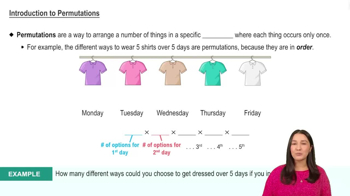
Permutations

Permutations refer to the different arrangements of a set of items where the order matters. In this context, since the band is selecting and arranging the first six songs from a total of 21, the number of permutations will determine how many unique sequences can be formed.
Recommended video:
07:11
Introduction to Permutations

Factorial Notation

Factorial notation, denoted as n!, represents the product of all positive integers up to n. It is crucial for calculating permutations, as the number of ways to arrange k items from n is given by the formula n! / (n-k)!, where k is the number of items to arrange.
Recommended video:
07:11
Introduction to Permutations

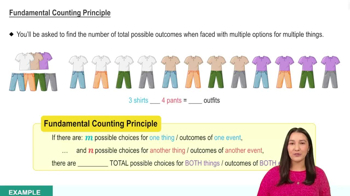
Combinatorial Counting

Combinatorial counting involves techniques for counting the arrangements or selections of items in a set. Understanding this concept helps in determining how many different ways the band can choose and order the first six songs from their setlist of 21.
Recommended video:
04:04
Fundamental Counting Principle