
Ch. 3 - Probability
Larson - Elementary Statistics: Picturing the World 8th Edition
Larson8th EditionElementary Statistics: Picturing the WorldISBN: 9780137493470Not the one you use?Change textbook
Chapter 3, Problem 3.1.2a

2. Determine whether each number could represent the probability of an event. Explain your reasoning. a. 25/25

Verified step by step guidance
1
Step 1: Recall the definition of probability. Probability is a measure of the likelihood of an event occurring, and it is always a value between 0 and 1, inclusive. This means probabilities cannot be negative or greater than 1.
Step 2: Simplify the given fraction, 25/25. Perform the division to determine its value. Mathematically, dividing any number by itself results in 1.
Step 3: Compare the simplified value (1) to the range of valid probabilities (0 ≤ P ≤ 1). Since 1 is within this range, it is a valid probability.
Step 4: Explain the reasoning. A probability of 1 indicates that the event is certain to occur. For example, if you have 25 favorable outcomes out of 25 possible outcomes, the event is guaranteed to happen.
Step 5: Conclude that the number 25/25 could represent the probability of an event because it simplifies to 1, which is within the valid range for probabilities.

Verified video answer for a similar problem:

This video solution was recommended by our tutors as helpful for the problem above.
Video duration:
1m
Was this helpful?

Key Concepts

Here are the essential concepts you must grasp in order to answer the question correctly.

Probability Range

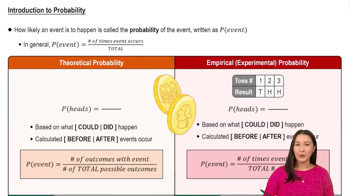
Probability is a measure of the likelihood of an event occurring, and it is always expressed as a number between 0 and 1. A probability of 0 indicates that an event will not occur, while a probability of 1 indicates certainty that the event will occur. Any value outside this range is not valid for representing probabilities.
Recommended video:
5:37
Introduction to Probability

Fraction Representation

Fractions can be used to express probabilities, where the numerator represents the number of favorable outcomes and the denominator represents the total number of possible outcomes. In the case of 25/25, this fraction simplifies to 1, which is a valid probability indicating certainty that the event will occur.
Recommended video:
5:37
Introduction to Probability

Interpretation of Probabilities

Understanding how to interpret probabilities is crucial. A probability of 1 (or 100%) means that the event is guaranteed to happen, while a probability of 0 (or 0%) means it cannot happen. Therefore, when evaluating whether a number can represent a probability, it is essential to consider its meaning in the context of possible outcomes.
Recommended video:
5:37
Introduction to Probability
Related Practice
Textbook Question

"39. Reliability of Testing A virus infects one in every 200 people. A test used to detect the virus in a person is positive 80% of the time when the person has the virus and 5% of the time when the person does not have the virus. (This 5% result is called a false positive.) Let A be the event ""the person is infected"" and B be the event ""the person tests positive.""

a. Using Bayes' Theorem, when a person tests positive, determine the probability that the person is infected."

1
views
Textbook Question

26. Eye Survey The table shows the results of a survey that asked 3203 people whether they wore contacts or glasses. A person is selected at random from the sample. Find the probability of each event.

a. The person wears only contacts or only glasses.

" style="" width="480">

Textbook Question

87. College Football A stem-and-leaf plot for the numbers of touchdowns allowed by the 127 NCAA Division I Football Bowl Subdivision teams in the 2020-2021 season is shown. Find the probability that a team chosen at random allowed (a) at least 51 touchdowns. Are any of these events unusual? Explain. (Source: National Collegiate Athletic Association)

" style="" width="610">

Textbook Question

U.S. Age Distribution The projected percent distribution of the U.S. population for 2025 is shown in the pie chart. Find the probability of each event. (Source: U.S. Census

Bureau)

a. Randomly selecting someone who is under 10 years old

Textbook Question

Using the Multiplication Rule In Exercises 19-32, use the Multiplication Rule.

23. Celebrities as Role Models In a sample of 1103 probable voters, three out of four say they would like entertainers to address social and political issues. Two probable voters are selected at random. (Source: The Hollywood Reporter)

a. Find the probability that both probable voters would like entertainers to address social and political issues.

Textbook Question

Using the Multiplication Rule In Exercises 19-32, use the Multiplication Rule.

25. Best President In a sample of 1500 adult U.S. citizens, 270 said that Barack Obama was the best president in U.S. history. Two adult U.S. citizens are selected at random.

(Adapted from YouGov)

a. Find the probability that both adult U.S. citizens say that Barack Obama was the best president in U.S. history.