Ch. 3 - Probability
Larson - Elementary Statistics: Picturing the World 8th Edition
Larson8th EditionElementary Statistics: Picturing the WorldISBN: 9780137493470Not the one you use?Change textbook
Chapter 3, Problem 3.3.18b

18. Rolling a Die You roll a die. Find the probability of each event.
b. Rolling a 2 or an odd number

Verified step by step guidance
1
Step 1: Understand the problem. A standard die has 6 faces numbered 1 through 6. The goal is to find the probability of rolling a 2 or an odd number. Recall that the probability of an event is calculated as the ratio of favorable outcomes to the total number of possible outcomes.
Step 2: Identify the total number of possible outcomes. Since the die has 6 faces, the total number of outcomes is 6.
Step 3: Determine the favorable outcomes for the event 'rolling a 2 or an odd number.' The odd numbers on a die are 1, 3, and 5. Additionally, the number 2 is included in the event. Therefore, the favorable outcomes are {1, 2, 3, 5}.
Step 4: Count the number of favorable outcomes. The set {1, 2, 3, 5} contains 4 outcomes.
Step 5: Calculate the probability. Use the formula \( P(E) = \frac{\text{Number of Favorable Outcomes}}{\text{Total Number of Outcomes}} \). Substitute the values: \( P(E) = \frac{4}{6} \). Simplify the fraction if needed.

Verified video answer for a similar problem:

This video solution was recommended by our tutors as helpful for the problem above.
Video duration:
3m
Was this helpful?

Key Concepts

Here are the essential concepts you must grasp in order to answer the question correctly.

Probability

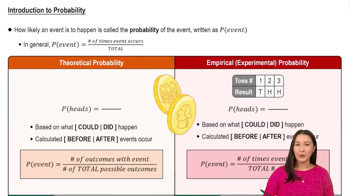
Probability is a measure of the likelihood that an event will occur, expressed as a number between 0 and 1. An event with a probability of 0 means it cannot happen, while a probability of 1 means it is certain to happen. In the context of rolling a die, the probability of an event can be calculated by dividing the number of favorable outcomes by the total number of possible outcomes.
Recommended video:
5:37
Introduction to Probability

Sample Space

The sample space is the set of all possible outcomes of a random experiment. For a single roll of a fair six-sided die, the sample space consists of the numbers {1, 2, 3, 4, 5, 6}. Understanding the sample space is crucial for calculating probabilities, as it provides the basis for determining how many outcomes are favorable for a given event.
Recommended video:
05:11
Sampling Distribution of Sample Proportion

Compound Events

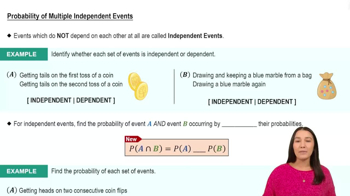
A compound event is an event that consists of two or more simple events. In this case, rolling a 2 or an odd number involves two simple events: rolling a 2 and rolling an odd number (1, 3, or 5). To find the probability of a compound event, one must consider the individual probabilities of each simple event and account for any overlap, ensuring that outcomes are not double-counted.
Recommended video:
05:54
Probability of Multiple Independent Events
Related Practice
Textbook Question

"Using the Multiplication Rule In Exercises 19-32, use the Multiplication Rule.

26. Worst President In a sample of 1500 adult U.S. citizens, 690 said that Donald Trump was the worst president in U.S. history. Three adult U.S. citizens are selected at random.

(Adapted from YouGov)

b. Find the probability that none of the three adult U.S. citizens say that Donald Trump was the worst president in U.S. history."

Textbook Question

Finding Conditional Probabilities In Exercises 7 and 8, use the table to find each conditional probability.

7. Business Degrees The table shows the numbers of male and female students in the United States who received bachelor's degrees in business and nonbusiness fields in a recent year. (Source: National Center for Educational Statistics)

b. Find the probability that a randomly selected bachelor's degree-earning student received a business degree, given that the student is female.

1
views
Textbook Question

Marijuana Use The percent distribution of the last marijuana use (either medical or nonmedical) for a sample of 13,373 college students is shown in the pie chart. Find the

probability of each event. (Source: American College Health Association)

a. Randomly selecting a student who never used marijuana

Textbook Question

Using the Multiplication Rule In Exercises 19-32, use the Multiplication Rule.

30. Standardized Test Scores According to a survey, 57.8% of college-seeking high school seniors say they have taken one of the standardized tests for potential college students. Of these, 35.6% say they do not plan to submit their score with their college applications. (Adapted from Niche)

b. Find the probability that a randomly selected college-seeking high school senior took one of the standardized tests and plans to submit this score with their college

applications.

Textbook Question

Using the Multiplication Rule In Exercises 19-32, use the Multiplication Rule.

28. Blood Types The probability that a Latinx American person in the United States has type A+ blood is 29%. Four Latinx American people in the United States are selected at random. (Source: American National Red Cross)

b. Find the probability that none of the four have type A+ blood.

Textbook Question

2. Determine whether each number could represent the probability of an event. Explain your reasoning. b. 333.3%