
Ch. 3 - Probability
Larson - Elementary Statistics: Picturing the World 8th Edition
Larson8th EditionElementary Statistics: Picturing the WorldISBN: 9780137493470Not the one you use?Change textbook
Chapter 3, Problem 3.3.16

16. Can Defects Of the cans produced by a company, 96% do not have a puncture, 93% do not have a smashed edge, and 89.3% have neither a puncture nor a smashed edge. Find
the probability that a randomly selected can does not have a puncture or a smashed edge.

Verified step by step guidance
1
Step 1: Define the events. Let A represent the event that a can does not have a puncture, and B represent the event that a can does not have a smashed edge. The probabilities given are P(A) = 0.96, P(B) = 0.93, and P(A ∩ B) = 0.893.
Step 2: Recall the formula for the union of two events. The probability that a can does not have a puncture or a smashed edge is given by P(A ∪ B) = P(A) + P(B) - P(A ∩ B).
Step 3: Substitute the given probabilities into the formula. Replace P(A) with 0.96, P(B) with 0.93, and P(A ∩ B) with 0.893 in the formula P(A ∪ B) = P(A) + P(B) - P(A ∩ B).
Step 4: Simplify the expression. Add P(A) and P(B), then subtract P(A ∩ B) to calculate P(A ∪ B).
Step 5: Interpret the result. The value of P(A ∪ B) represents the probability that a randomly selected can does not have a puncture or a smashed edge.

Verified video answer for a similar problem:

This video solution was recommended by our tutors as helpful for the problem above.
Video duration:
2m
Was this helpful?

Key Concepts

Here are the essential concepts you must grasp in order to answer the question correctly.

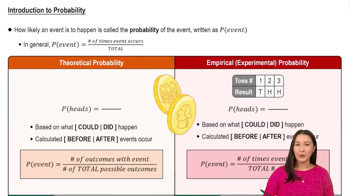
Probability

Probability is a measure of the likelihood that an event will occur, expressed as a number between 0 and 1. In this context, it helps quantify the chances of a can being free from defects, such as punctures or smashed edges. Understanding how to calculate probabilities is essential for solving the question.
Recommended video:
5:37
Introduction to Probability

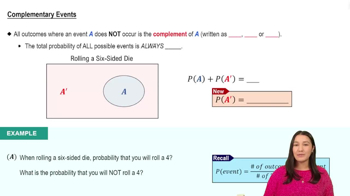
Complement Rule

The Complement Rule states that the probability of an event not occurring is equal to 1 minus the probability of the event occurring. This concept is crucial for determining the probability of a can not having a puncture or a smashed edge by using the given probabilities of the defects.
Recommended video:
4:23
Complementary Events

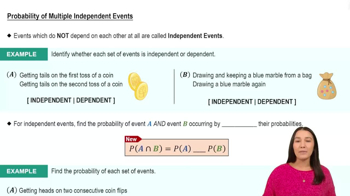
Union of Events

The Union of Events refers to the probability that at least one of multiple events occurs. In this case, it involves calculating the probability that a can has either a puncture or a smashed edge. Understanding how to combine probabilities of different events is key to finding the solution.
Recommended video:
05:54
Probability of Multiple Independent Events