Ch. 3 - Probability
Larson - Elementary Statistics: Picturing the World 8th Edition
Larson8th EditionElementary Statistics: Picturing the WorldISBN: 9780137493470Not the one you use?Change textbook
Chapter 3, Problem 3.3.1

1. When two events are mutually exclusive, why is P(A and B) = 0?

Verified step by step guidance
1
Understand the concept of mutually exclusive events: Two events are mutually exclusive if they cannot occur at the same time. For example, flipping a coin and getting both heads and tails simultaneously is impossible, making these events mutually exclusive.
Recall the definition of the intersection of events: The intersection of two events, denoted as P(A and B), represents the probability that both events A and B occur simultaneously.
Apply the property of mutually exclusive events: Since mutually exclusive events cannot happen at the same time, the intersection of these events is empty. Mathematically, this means P(A and B) = 0.
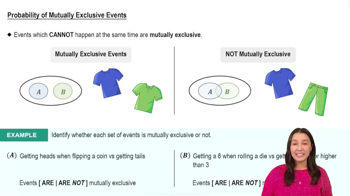
Visualize the concept using a Venn diagram: In a Venn diagram, mutually exclusive events do not overlap. The absence of overlap visually confirms that P(A and B) = 0.
Conclude with the reasoning: The probability of two mutually exclusive events occurring together is zero because their definitions inherently prevent simultaneous occurrence.

Verified video answer for a similar problem:

This video solution was recommended by our tutors as helpful for the problem above.
Video duration:
1m
Was this helpful?

Key Concepts

Here are the essential concepts you must grasp in order to answer the question correctly.

Mutually Exclusive Events

Mutually exclusive events are those that cannot occur simultaneously. If one event happens, the other cannot. For example, when flipping a coin, getting heads and tails at the same time is impossible. This concept is crucial for understanding why the probability of both events occurring together is zero.
Recommended video:
5:14
Probability of Mutually Exclusive Events

Probability of Events

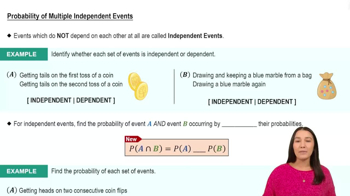
Probability is a measure of the likelihood that an event will occur, expressed as a number between 0 and 1. The probability of two events occurring together, denoted as P(A and B), is calculated based on their individual probabilities. For mutually exclusive events, since they cannot happen at the same time, the probability of both occurring is always zero.
Recommended video:
05:54
Probability of Multiple Independent Events

Addition Rule of Probability

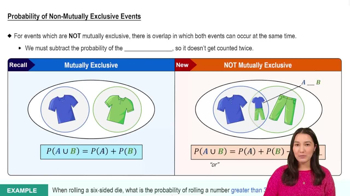
The addition rule of probability states that for any two events A and B, the probability of either A or B occurring is the sum of their individual probabilities, minus the probability of both occurring together. For mutually exclusive events, since P(A and B) = 0, the rule simplifies to P(A or B) = P(A) + P(B), reinforcing that they cannot happen at the same time.
Recommended video:
5:14
Probability of Non-Mutually Exclusive Events
Related Practice
Textbook Question

"According to Bayes’ Theorem, the probability of event A , given that event B has occurred, is

P(A|B) = P(A) * P(B|A)P(A) * P(B|A) + P(A') * P(B|A').

In Exercises 33–38, use Bayes’ Theorem to find P(A|B).

35. P(A) = 0.25, P(A') = 0.75, P(B|A) = 0.3 , and P(B|A') = 0.5 "

1
views
Textbook Question

True or False? In Exercises 3-6, determine whether the statement is true or false. If it is false, rewrite it as a true statement.

3. A combination is an ordered arrangement of objects.

Textbook Question

Cards In Exercises 59-62, you are dealt a hand of five cards from a standard deck of 52 playing cards.

62. Find the probability of being dealt three of a kind (the other two cards are different from each other).

Textbook Question

Matching Probabilities In Exercises 11-16, match the event with its probability.

a. 0.95

b. 0.005

c. 0.25

d. 0

e. 0.375

f. 0.5

11. A random number generator is used to select a number from 1 to 100. What is the probability of selecting the number 153?

Textbook Question

Classifying Events Based on Studies In Exercises 15-18, identify the two events described in the study. Do the results indicate that the events are independent or dependent? Explain your reasoning.

17. A study found that there is no relationship between playing violent video games and aggressive or bullying behavior in teenagers. (Source: The Royal Society Publishing)

Textbook Question

Boy or Girl? In Exercises 71-74, a couple plans to have three children. Each child is equally likely to be a boy or a girl.

74. What is the probability that at least one child is a boy?