Ch. 2 - Descriptive Statistics
Larson - Elementary Statistics: Picturing the World 8th Edition
Larson8th EditionElementary Statistics: Picturing the WorldISBN: 9780137493470Not the one you use?Change textbook
Chapter 2, Problem 2.DS.2a

You are a member of your local apartment association. The association represents rental housing owners and managers who operate residential rental property throughout the greater metropolitan area. Recently, the association has received several complaints from tenants in a particular area of the city who feel that their monthly rental fees are much higher compared to other parts of the city.
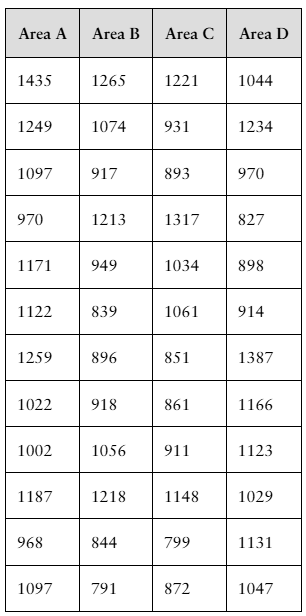
You want to investigate the rental fees. You gather the data shown in the table at the right. Area A represents the area of the city where tenants are unhappy about their monthly rents. The data represent the monthly rents paid by a random sample of tenants in Area A and three other areas of similar size. Assume all the apartments represented are approximately the same size with the same amenities.
Table displaying monthly rental fees for tenants in four city areas, highlighting Area A's higher rents.
a. What type of graph would you choose to display the data? Explain your reasoning.

Verified step by step guidance
1
Step 1: Identify the type of data provided. The table contains numerical data representing monthly rental fees for tenants in four different areas (Area A, Area B, Area C, and Area D). Each column corresponds to a specific area, and each row represents a sample observation.
Step 2: Consider the purpose of the graph. Since the goal is to compare rental fees across different areas and investigate whether Area A has higher rents, a graph that allows for easy comparison of distributions is ideal.
Step 3: Choose an appropriate graph type. A box-and-whisker plot (boxplot) is a suitable choice because it visually summarizes the distribution of rental fees for each area, showing measures like the median, quartiles, and potential outliers. This helps identify differences in central tendency and variability between areas.
Step 4: Explain why a boxplot is effective. A boxplot provides a clear visual comparison of the spread and center of the data for each area. It highlights whether Area A has higher rents compared to other areas by showing the median and range of values. Additionally, it can reveal if there are outliers in the data.
Step 5: Prepare the data for graphing. Organize the rental fees for each area and calculate the necessary statistics (minimum, first quartile, median, third quartile, and maximum) to construct the boxplot. Ensure the data is grouped by area for clarity in the graph.

Verified video answer for a similar problem:

This video solution was recommended by our tutors as helpful for the problem above.
Video duration:
2m
Was this helpful?

Key Concepts

Here are the essential concepts you must grasp in order to answer the question correctly.

Data Visualization

Data visualization is the graphical representation of information and data. By using visual elements like charts, graphs, and maps, it helps to make complex data more accessible and understandable. In this context, choosing the right type of graph is crucial to effectively communicate the differences in rental fees across different areas.
Recommended video:
Guided course
04:39
Visualizing Qualitative vs. Quantitative Data

Comparative Analysis

Comparative analysis involves evaluating two or more items to identify similarities and differences. In this scenario, it is essential to compare the rental fees from Area A with those from Areas B, C, and D to determine if the complaints about higher rents are justified. This analysis can reveal trends and patterns in rental pricing across different areas.
Recommended video:
Guided course
04:48
Comparing Mean vs. Median

Descriptive Statistics

Descriptive statistics summarize and describe the main features of a dataset. Key measures include mean, median, mode, and range, which provide insights into the central tendency and variability of rental prices. Understanding these statistics is vital for interpreting the data and making informed decisions based on the rental fee comparisons.
Recommended video:
Guided course
05:53
Parameters vs. Statistics
Related Practice
Textbook Question

Refer to the sample statistics from Exercise 5 and determine whether any of the house prices below are unusual. Explain your reasoning.


d. \$147,000
Textbook Question

The mean annual salary for a sample of electrical engineers is \$86,500, with a standard deviation of \(1500. The data set has a bell-shaped distribution.


b. The salaries of three randomly selected electrical engineers are \)93,500, \$85,600, and \$82,750. Find the z-score that corresponds to each salary. Determine whether any of these salaries are unusual.

Textbook Question

Tail lengths (in feet) for a sample of American alligators are listed.

6.5 3.4 4.2 7.1 5.4 6.8 7.5 3.9 4.6


a. Find the mean, median, and mode of the tail lengths. Which best describes a typical American alligator tail length? Explain your reasoning.

Textbook Question

The data set represents the number of minutes a sample of 27 people exercise each week.

108 139 120 123 120 132 123 131 131

157 150 124 111 101 135 119 116 117

127 128 139 119 118 114 127 142 130


d. Describe the shape of the distribution as symmetric, uniform, skewed left, skewed right, or none of these.

Textbook Question

You are a member of your local apartment association. The association represents rental housing owners and managers who operate residential rental property throughout the greater metropolitan area. Recently, the association has received several complaints from tenants in a particular area of the city who feel that their monthly rental fees are much higher compared to other parts of the city.

You want to investigate the rental fees. You gather the data shown in the table at the right. Area A represents the area of the city where tenants are unhappy about their monthly rents. The data represent the monthly rents paid by a random sample of tenants in Area A and three other areas of similar size. Assume all the apartments represented are approximately the same size with the same amenities.

c. Based on your data displays, does it appear that the monthly rents in Area A are higher than the rents in the other areas of the city? Explain.

Textbook Question

Weekly salaries (in dollars) for a sample of construction workers are listed.

1100 720 1384 1124 1255 976 718 1316

749 1062 1248 891 969 790 860 1100


a. Find the mean, median, and mode of the salaries. Which best describes a typical salary?