Ch. 2 - Descriptive Statistics
Larson - Elementary Statistics: Picturing the World 8th Edition
Larson8th EditionElementary Statistics: Picturing the WorldISBN: 9780137493470Not the one you use?Change textbook
Chapter 2, Problem 2.3.25

Using and Interpreting Concepts


Finding and Discussing the Mean, Median, and Mode In Exercises 17–34, find the mean, the median, and the mode of the data, if possible. If any measure cannot be found or does not represent the center of the data, explain why.


Power Failures The durations (in minutes) of power failures at a residence in the last 10 years
18 26 45 75 125 80 33
40 44 49 89 80 96 125
12 61 31 63 103 28 19

Verified step by step guidance
1
Step 1: Organize the data set in ascending order to make calculations easier. The given durations are: 12, 18, 19, 26, 28, 31, 40, 44, 45, 49, 61, 63, 75, 80, 80, 89, 96, 103, 125, 125.
Step 2: Calculate the mean (average). Add all the values together and divide by the total number of values. Use the formula: Mean=xn, where x represents each data point and n is the total number of data points.
Step 3: Find the median. The median is the middle value when the data is ordered. If the number of data points is odd, the median is the middle value. If even, the median is the average of the two middle values. Since there are 20 values, find the average of the 10th and 11th values in the ordered list.
Step 4: Determine the mode. The mode is the value that appears most frequently in the data set. Count the frequency of each value to identify the mode. If no value repeats, the data set has no mode.
Step 5: Interpret the results. Discuss whether the mean, median, and mode represent the center of the data effectively. Consider factors such as the presence of outliers (e.g., very high or very low values) and whether the measures provide a meaningful summary of the data distribution.

Verified video answer for a similar problem:

This video solution was recommended by our tutors as helpful for the problem above.
Video duration:
3m
Was this helpful?

Key Concepts

Here are the essential concepts you must grasp in order to answer the question correctly.

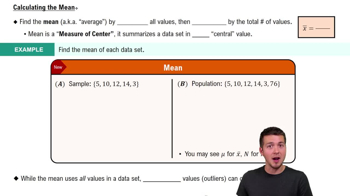
Mean

The mean, or average, is calculated by summing all the values in a dataset and dividing by the number of values. It provides a central value that represents the dataset as a whole. However, the mean can be sensitive to extreme values (outliers), which may skew the result and not accurately reflect the data's center.
Recommended video:
Guided course
04:52
Calculating the Mean

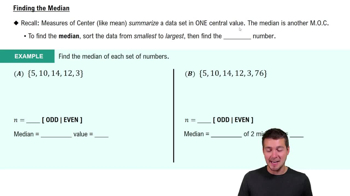
Median

The median is the middle value of a dataset when the values are arranged in ascending order. If there is an even number of observations, the median is the average of the two middle values. The median is a robust measure of central tendency, as it is less affected by outliers and skewed data compared to the mean.
Recommended video:
Guided course
03:26
Calculating the Median

Mode

The mode is the value that appears most frequently in a dataset. A dataset may have one mode (unimodal), more than one mode (bimodal or multimodal), or no mode at all if all values occur with the same frequency. The mode is particularly useful for categorical data where we wish to know the most common category.
Recommended video:
Guided course
07:10
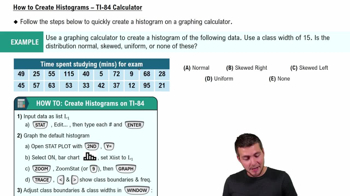
How to Create Histogram - TI-84 Calculator
Related Practice
Textbook Question

Graphical Analysis In Exercises 59 and 60, the letters A, B, and C are marked on the horizontal axis. Describe the shape of the data. Then determine which is the mean, which is the median, and which is the mode. Justify your answers.


" style="" width="270">

Textbook Question

Phone Screen Sizes Display the data below in a dot plot. Describe the differences in how the stem-and-leaf plot and the dot plot show patterns in the data.

1
views
Textbook Question

Building Basic Skills and Vocabulary


Describe the relationship between quartiles and percentiles.

Textbook Question

Graphing Data Sets In Exercises 17–32, organize the data using the indicated type of graph. Describe any patterns.


Life Spans of Houseflies Use a dot plot to display the data, which represent the life spans (in days) of 30 houseflies. 

9 9 4 11 10 5 13 9 7 11 6 8 14 10 6 

10 10 7 14 11 7 8 6 13 10 14 14 8 13 10

1
views
Textbook Question

Constructing a Frequency Distribution and a Frequency Polygon In Exercises 35 and 36, construct a frequency distribution and a frequency polygon for the data set using the indicated number of classes. Describe any patterns.

Ages of the Presidents Number of classes: 7 Data set: Ages of the U.S. presidents at Inauguration (Source: The White House) 57 61 57 57 58 57 61 54 68 51 49 64 50 48 65 52 56 46 54 49 51 47 55 55 54 42 51 56 55 51 54 51 60 62 43 55 56 61 52 69 64 46 54 47 70 78

Textbook Question

Graphical Analysis In Exercises 13 and 14, use the box-and-whisker plot to identify the five-number summary.

1
views