Ch. 2 - Descriptive Statistics
Larson - Elementary Statistics: Picturing the World 8th Edition
Larson8th EditionElementary Statistics: Picturing the WorldISBN: 9780137493470Not the one you use?Change textbook
Chapter 2, Problem 2.2.54a

Shifting Data Sample annual salaries (in thousands of dollars) for employees at a company are listed.
40   35   49   53   38   39   40
37   49   34   38   43   47   35


a. Find the sample mean and the sample standard deviation.

Verified step by step guidance
1
Step 1: Calculate the sample mean. The sample mean is the average of the data points. Use the formula: = xin, where xi is the sum of all data points and n is the number of data points.
Step 2: Add all the data points together to find xi. The data points are: 40, 35, 49, 53, 38, 39, 40, 37, 49, 34, 38, 43, 47, 35.
Step 3: Divide the sum of the data points by the total number of data points (n) to calculate the sample mean.
Step 4: Calculate the sample standard deviation using the formula: s = (xi - )2n - 1. Subtract the sample mean from each data point, square the result, and sum these squared differences.
Step 5: Divide the sum of squared differences by n - 1 (degrees of freedom), then take the square root of the result to find the sample standard deviation.

Verified video answer for a similar problem:

This video solution was recommended by our tutors as helpful for the problem above.
Video duration:
3m
Was this helpful?

Key Concepts

Here are the essential concepts you must grasp in order to answer the question correctly.

Sample Mean

The sample mean is the average of a set of values, calculated by summing all the data points and dividing by the number of points. It provides a central value that represents the data set, making it easier to understand the overall trend. In this case, it helps summarize the annual salaries of employees at the company.
Recommended video:
05:11
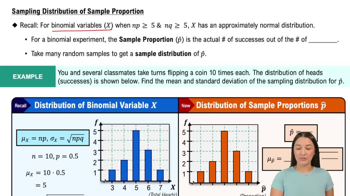
Sampling Distribution of Sample Proportion

Sample Standard Deviation

The sample standard deviation measures the amount of variation or dispersion in a set of values. It indicates how much individual data points differ from the sample mean. A low standard deviation suggests that the data points are close to the mean, while a high standard deviation indicates greater variability among the salaries.
Recommended video:
Guided course
08:45
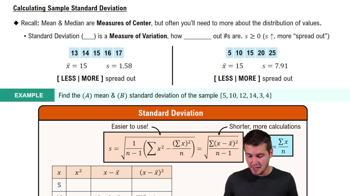
Calculating Standard Deviation

Data Shifting

Data shifting refers to the process of adjusting the values in a data set, often to analyze the effects of changes in the data. In the context of this question, understanding how to calculate the mean and standard deviation after shifting the data can provide insights into how such adjustments impact the overall statistics of the salaries.
Recommended video:
Guided course
04:39
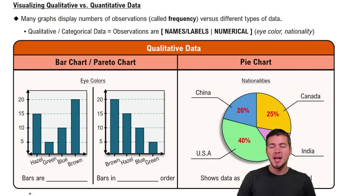
Visualizing Qualitative vs. Quantitative Data
Related Practice
Textbook Question

Archaeology The depths (in inches) at which 10 artifacts are found are listed. 

20.7 24.8 30.5 26.2 36.0 34.3 30.3 29.5 27.0 38.5


a. Find the range of the data set.
Textbook Question

Protein Powder During a quality assurance check, the actual contents (in grams) of six containers of protein powder were recorded as 1525, 1526, 1502, 1516, 1529, and 1511.


a. Find the mean and the median of the contents.

Textbook Question

Pearson’s Index of Skewness The English statistician Karl Pearson (1857–1936) introduced a formula for the skewness of a distribution.

P = 3 (x̄ - median) / s

Most distributions have an index of skewness between -3 and 3. When P > 0, the data are skewed right. When P < 0, the data are skewed left. When P = 0, the data are symmetric. Calculate the coefficient of skewness for each distribution. Describe the shape of each.


a. x̄ = 17, s = 2.3, median = 19

Textbook Question

Drawing a Box-and-Whisker Plot In Exercises 15–18,

(a) find the five-number summary


4 7 7 5 2 9 7 6 8 5 8 4 1 5 2 8 7 6 6 9

1
views
Textbook Question

Scaling Data Sample annual salaries (in thousands of dollars) for employees at a company are listed.

42   36   48   51   39   39   42

36   48   33   39   42   45   50

b. Each employee in the sample receives a 5% raise. Find the sample mean and the sample standard deviation for the revised data set.

Textbook Question

Extending Concepts


Alternative Formula You used SSₓ = Σ(x − x̄)² when calculating variance and standard deviation. An alternative formula that is sometimes more convenient for hand calculations is

SSₓ = Σ x² − (Σ x)² / n.

You can find the sample variance by dividing the sum of squares by n − 1 and the sample standard deviation by finding the square root of the sample variance.


b. Use the alternative formula to calculate the sample standard deviation for the data set in Exercise 15.