
Ch. 2 - Descriptive Statistics
Larson - Elementary Statistics: Picturing the World 8th Edition
Larson8th EditionElementary Statistics: Picturing the WorldISBN: 9780137493470Not the one you use?Change textbook
Chapter 2, Problem 2.4.20

Salary Offers You are applying for jobs at two companies. Company C offers starting salaries with μ = \(59,000 and σ = \)1500. Company D offers starting salaries with μ = \(59,000 and σ = \)1000. From which company are you more likely to get an offer of \$62,000 or more? Explain your reasoning.

Verified step by step guidance
1
Step 1: Recognize that the problem involves comparing probabilities of getting a salary offer of \(62,000 or more from two companies. This requires calculating the z-scores for \)62,000 for both companies, as the z-score standardizes the value relative to the mean and standard deviation of each distribution.
Step 2: Use the z-score formula: z = (X - μ) / σ, where X is the value of interest (\$62,000), μ is the mean salary, and σ is the standard deviation. For Company C, substitute μ = 59,000 and σ = 1,500 into the formula.
Step 3: Similarly, calculate the z-score for Company D using the same formula, but substitute μ = 59,000 and σ = 1,000.
Step 4: Once the z-scores are calculated for both companies, use a standard normal distribution table (or a statistical software) to find the probability corresponding to each z-score. Since the problem asks for \$62,000 or more, calculate the area to the right of the z-score (1 - cumulative probability).
Step 5: Compare the probabilities for both companies. The company with the smaller probability of \$62,000 or more is less likely to offer that salary, while the company with the larger probability is more likely. Explain your reasoning based on the spread (standard deviation) of the distributions.

Verified video answer for a similar problem:

This video solution was recommended by our tutors as helpful for the problem above.
Video duration:
1m
Was this helpful?

Key Concepts

Here are the essential concepts you must grasp in order to answer the question correctly.

Normal Distribution

Normal distribution is a probability distribution that is symmetric about the mean, showing that data near the mean are more frequent in occurrence than data far from the mean. In this context, both companies' salary offers can be modeled as normal distributions, characterized by their mean (μ) and standard deviation (σ). Understanding this concept is crucial for determining the likelihood of receiving a salary offer above a certain threshold.
Recommended video:
06:23
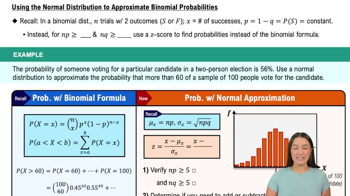
Using the Normal Distribution to Approximate Binomial Probabilities

Z-Score

A Z-score indicates how many standard deviations an element is from the mean. It is calculated using the formula Z = (X - μ) / σ, where X is the value of interest. By calculating the Z-scores for the $62,000 salary offer for both companies, we can compare how likely it is to receive such an offer relative to each company's salary distribution.
Recommended video:
Guided course
06:31
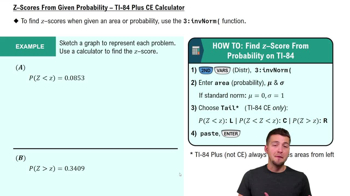
Z-Scores From Given Probability - TI-84 (CE) Calculator

Probability and Area Under the Curve

In the context of normal distributions, the probability of a certain outcome can be determined by calculating the area under the curve of the distribution. This area represents the likelihood of receiving a salary offer of $62,000 or more. By using Z-scores to find the corresponding probabilities from standard normal distribution tables, we can assess which company is more likely to provide a higher salary offer.
Recommended video:
Guided course
08:50
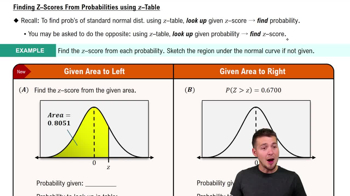
Z-Scores from Probabilities
Related Practice
Textbook Question

Estimating the Sample Mean and Standard Deviation for Grouped Data In Exercises 41–44, make a frequency distribution for the data. Then use the table to estimate the sample mean and the sample standard deviation of the data set.

Weekly Study Hours The distribution of the number of hours that a random sample of college students study per week is shown in the pie chart. Use 32 as the midpoint for “30+ hours.”

Textbook Question

Graphical Analysis In Exercises 9–12, use the stem-and-leaf plot or dot plot to list the actual data entries. What is the maximum data entry? What is the minimum data entry?


" style="" width="385">

2
views
Textbook Question

Graphical Analysis In Exercises 21–24, you are asked to compare three data sets.


(c) Estimate the sample standard deviations. Then determine how close each of your estimates is by finding the sample standard deviations.


i. ii. iii.

Textbook Question

Constructing Data Sets In Exercises 25–28, construct a data set that has the given statistics.


n = 6

x̄ = 7

s ≈ 2

Textbook Question

Matching In Exercises 13–16, match the distribution with one of the graphs in Exercises 9–12. Justify your decision.

The frequency distribution of mileages of service vehicles at a business where a few vehicles have much higher mileages than the majority of vehicles

1
views
Textbook Question

Graphical Analysis In Exercises 19–22, use the box-and-whisker plot to determine whether the shape of the distribution represented is symmetric, skewed left, skewed right, or none of these. Justify your answer.