
Ch. 2 - Descriptive Statistics
Larson - Elementary Statistics: Picturing the World 8th Edition
Larson8th EditionElementary Statistics: Picturing the WorldISBN: 9780137493470Not the one you use?Change textbook
Chapter 2, Problem 2.5.63

Project Find a real-life data set and use the techniques of Chapter 2, including graphs and numerical quantities, to discuss the center, variation, and shape of the data set. Describe any patterns.

Verified step by step guidance
1
Identify a real-life data set: Choose a data set that interests you and is relevant to the analysis. For example, you could use data on daily temperatures, stock prices, or exam scores. Ensure the data set has enough observations to perform meaningful statistical analysis.
Organize the data: Arrange the data in a clear and structured format, such as a table or spreadsheet. If the data is raw, clean it by removing any errors, duplicates, or missing values.
Create visualizations: Use graphs such as histograms, box plots, or stem-and-leaf plots to visualize the data. These graphs will help you understand the shape of the data distribution (e.g., symmetric, skewed, unimodal, bimodal).
Calculate numerical measures: Compute measures of center (mean, median, mode) and measures of variation (range, variance, standard deviation, interquartile range). These values will provide insights into the central tendency and spread of the data.
Interpret and describe patterns: Analyze the graphs and numerical measures to discuss the center, variation, and shape of the data. Look for any patterns, trends, or outliers, and summarize your findings in a clear and concise manner.

Verified video answer for a similar problem:

This video solution was recommended by our tutors as helpful for the problem above.
Video duration:
6m
Was this helpful?

Key Concepts

Here are the essential concepts you must grasp in order to answer the question correctly.

Descriptive Statistics

Descriptive statistics summarize and describe the main features of a data set. This includes measures of central tendency, such as the mean and median, which indicate the center of the data, as well as measures of variation, like range and standard deviation, which show how spread out the data points are. Graphical representations, such as histograms and box plots, also fall under this category, providing visual insights into the data's distribution.
Recommended video:
Guided course
05:53
Parameters vs. Statistics

Center of Data

The center of a data set refers to a value that represents a typical or average data point. Common measures include the mean, which is the arithmetic average, and the median, which is the middle value when data is ordered. Understanding the center helps in identifying where most data points lie and is crucial for comparing different data sets.
Recommended video:
Guided course
04:39
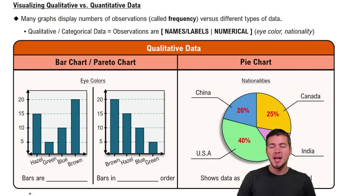
Visualizing Qualitative vs. Quantitative Data

Variation in Data

Variation refers to how much the data points differ from each other and from the center. It is quantified using statistics such as range, variance, and standard deviation. High variation indicates that data points are spread out over a wide range of values, while low variation suggests that they are clustered closely around the center. Analyzing variation is essential for understanding the reliability and consistency of the data.
Recommended video:
Guided course
04:39
Visualizing Qualitative vs. Quantitative Data
Related Practice
Textbook Question

Construct a frequency distribution and a frequency histogram for the data set using the indicated number of classes. Describe any patterns.

Reaction Times

Number of classes: 8

Data set: Reaction times (in milliseconds) of 30 adult females to an auditory stimulus 507 389 305 291 336 310 514 442 373 428 387 454 323 441 388 426 411 382 320 450 309 416 359 388 307 337 469 351 422 413

1
views
Textbook Question

Extending Concepts


A Misleading Graph? A misleading graph is not drawn appropriately, which can misrepresent data and lead to false conclusions. In Exercises 37–40, (a) explain why the graph is misleading, and (b) redraw the graph so that it is not misleading.


Textbook Question

use the given information about the data set and the number of classes to find the class width, the lower class limits, and the upper class limits.

min=17, range=118, 8 classes

1
views
Textbook Question

What is the difference between a frequency polygon and an ogive?

1
views
Textbook Question

Finding and Interpreting Percentiles In Exercises 37– 40, use the data set, which represents wait times (in minutes) for various services at a state’s Department of Motor Vehicles locations.

6 10 1 22 23 10 6 7 2 1 6 6 2 4 14 15 16 4

19 3 19 26 5 3 4 7 6 10 9 10 20 18 3 20 10 13

14 11 14 17 4 27 4 8 4 3 26 18 21 1 3 3 5 5

Which wait time represents the 50th percentile? How would you interpret this?

Textbook Question

Finding z-Scores The distribution of the ages of the winners of the Tour de France from 1903 to 2020 is approximately bell-shaped. The mean age is 27.9 years, with a standard deviation of 3.4 years. In Exercises 43–48, use the corresponding z-score to determine whether the age is unusual. Explain your reasoning. (Source: Le Tour de France)