Ch. 2 - Descriptive Statistics
Larson - Elementary Statistics: Picturing the World 8th Edition
Larson8th EditionElementary Statistics: Picturing the WorldISBN: 9780137493470Not the one you use?Change textbook
Chapter 2, Problem 2.5.50b

Life Spans of Fruit Flies The life spans of a species of fruit fly have a bell-shaped distribution, with a mean of 33 days and a standard deviation of 4 days.


b. The life spans of three randomly selected fruit flies are 29 days, 41 days, and 25 days. Using the Empirical Rule, find the percentile that corresponds to each life span.

Verified step by step guidance
1
Step 1: Recall the Empirical Rule, which states that for a bell-shaped (normal) distribution: approximately 68% of the data falls within 1 standard deviation (σ) of the mean (μ), 95% within 2σ, and 99.7% within 3σ. This will help us determine the percentiles.
Step 2: Calculate the z-score for each life span using the formula: z = (X - μ) / σ, where X is the observed value, μ is the mean, and σ is the standard deviation. For example, for 29 days, z = (29 - 33) / 4.
Step 3: Use the z-scores to determine how many standard deviations each life span is from the mean. For example, a z-score of -1 indicates the value is 1 standard deviation below the mean.
Step 4: Refer to the Empirical Rule to estimate the percentile for each z-score. For instance, a z-score of -1 corresponds to approximately the 16th percentile, as 68% of the data is within 1σ, leaving 16% below 1σ on the left side.
Step 5: Repeat the process for the other two life spans (41 days and 25 days), calculating their z-scores and using the Empirical Rule to estimate their percentiles.

Verified video answer for a similar problem:

This video solution was recommended by our tutors as helpful for the problem above.
Video duration:
5m
Was this helpful?

Key Concepts

Here are the essential concepts you must grasp in order to answer the question correctly.

Normal Distribution

Normal distribution is a probability distribution that is symmetric about the mean, showing that data near the mean are more frequent in occurrence than data far from the mean. It is characterized by its bell-shaped curve, defined by its mean and standard deviation. In this context, the life spans of fruit flies follow a normal distribution with a mean of 33 days and a standard deviation of 4 days.
Recommended video:
06:23
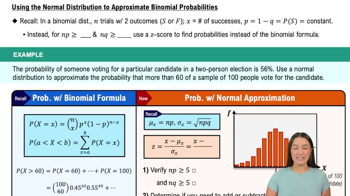
Using the Normal Distribution to Approximate Binomial Probabilities

Empirical Rule

The Empirical Rule, also known as the 68-95-99.7 rule, states that for a normal distribution, approximately 68% of the data falls within one standard deviation of the mean, 95% within two standard deviations, and 99.7% within three standard deviations. This rule helps in understanding how data is spread around the mean and is essential for calculating percentiles in normally distributed data.
Recommended video:
5:14
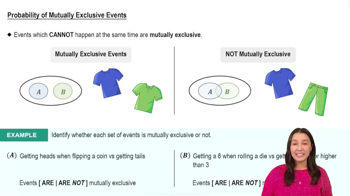
Probability of Mutually Exclusive Events

Percentiles

A percentile is a measure used in statistics indicating the value below which a given percentage of observations in a group of observations falls. For example, the 25th percentile is the value below which 25% of the data points lie. In this question, calculating the percentiles for the life spans of the selected fruit flies involves determining how each lifespan compares to the overall distribution of lifespans.
Related Practice
Textbook Question

Drawing a Box-and-Whisker Plot In Exercises 15–18,

(b) draw a box-and-whisker plot that represents the data set.


39 36 30 27 26 24 28 35 39 60 50 41 35 32 51
Textbook Question

Use the relative frequency histogram to

approximate the greatest and least relative frequencies.

Textbook Question

Scaling Data Sample annual salaries (in thousands of dollars) for employees at a company are listed.

42   36   48   51   39   39   42

36   48   33   39   42   45   50

b. Each employee in the sample receives a 5% raise. Find the sample mean and the sample standard deviation for the revised data set.

Textbook Question

Drawing a Box-and-Whisker Plot In Exercises 15–18,

(b) draw a box-and-whisker plot that represents the data set.


2 7 1 3 1 2 8 9 9 2 5 4 7 3 7 5 4

2 3 5 9 5 6 3 9 3 4 9 8 8 2 3 9 5

Textbook Question

Extending Concepts


Alternative Formula You used SSₓ = Σ(x − x̄)² when calculating variance and standard deviation. An alternative formula that is sometimes more convenient for hand calculations is

SSₓ = Σ x² − (Σ x)² / n.

You can find the sample variance by dividing the sum of squares by n − 1 and the sample standard deviation by finding the square root of the sample variance.


b. Use the alternative formula to calculate the sample standard deviation for the data set in Exercise 15.

Textbook Question

Extending Concepts


Golf The distances (in yards) for nine holes of a golf course are listed.

336 393 408 522 147 504 177 375 360


b. Convert the distances to feet. Then rework part (a).

7
views