Ch. 2 - Descriptive Statistics
Larson - Elementary Statistics: Picturing the World 8th Edition
Larson8th EditionElementary Statistics: Picturing the WorldISBN: 9780137493470Not the one you use?Change textbook
Chapter 2, Problem 2.5.3

Building Basic Skills and Vocabulary


A student’s grade on the Fundamentals of Engineering exam has a z-score of −0.5. Make an observation about the student’s grade.

Verified step by step guidance
1
Understand the concept of a z-score: A z-score measures how many standard deviations a data point is from the mean. A negative z-score indicates the data point is below the mean, while a positive z-score indicates it is above the mean.
Interpret the given z-score: The z-score of -0.5 means the student’s grade is 0.5 standard deviations below the mean grade of all students who took the exam.
Relate the z-score to the normal distribution: In a standard normal distribution, most data points fall within 1 standard deviation of the mean. A z-score of -0.5 suggests the student’s grade is relatively close to the mean, but slightly below it.
Make an observation: Since the z-score is not very far from 0, the student’s grade is not significantly different from the average grade of the group.
Conclude: The student’s performance is slightly below average, but not drastically so, based on the z-score of -0.5.

Verified video answer for a similar problem:

This video solution was recommended by our tutors as helpful for the problem above.
Video duration:
1m
Was this helpful?

Key Concepts

Here are the essential concepts you must grasp in order to answer the question correctly.

Z-Score

A z-score indicates how many standard deviations a data point is from the mean of a dataset. A z-score of -0.5 means the student's grade is half a standard deviation below the average score of all students who took the exam. This helps in understanding the relative performance of the student compared to their peers.
Recommended video:
Guided course
06:31
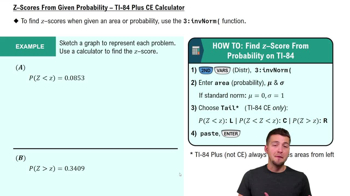
Z-Scores From Given Probability - TI-84 (CE) Calculator

Standard Deviation

Standard deviation is a measure of the amount of variation or dispersion in a set of values. A low standard deviation indicates that the values tend to be close to the mean, while a high standard deviation indicates that the values are spread out over a wider range. In the context of the z-score, it helps to contextualize how unusual or typical the student's performance is.
Recommended video:
Guided course
08:45
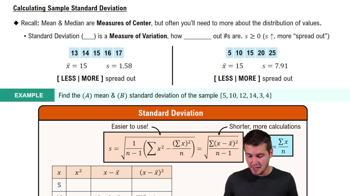
Calculating Standard Deviation

Normal Distribution

Normal distribution is a probability distribution that is symmetric about the mean, showing that data near the mean are more frequent in occurrence than data far from the mean. Many exam scores follow a normal distribution, which allows the use of z-scores to compare individual scores to the overall performance of the group, providing insights into how well a student performed relative to others.
Recommended video:
06:23
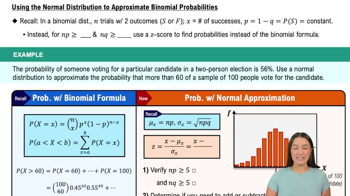
Using the Normal Distribution to Approximate Binomial Probabilities