
Ch. 10 - Chi-Square Tests and the F-Distribution
Larson - Elementary Statistics: Picturing the World 8th Edition
Larson8th EditionElementary Statistics: Picturing the WorldISBN: 9780137493470Not the one you use?Change textbook
Chapter 10, Problem 10.4.11

Performing a One-Way ANOVA Test In Exercises 5–14, (a) identify the claim and state H0 and Ha, (b) find the critical value and identify the rejection region, (c) find the test statistic F, (d) decide whether to reject or fail to reject the null hypothesis, and (e) interpret the decision in the context of the original claim. Assume the samples are random and independent, the populations are normally distributed, and the population variances are equal.


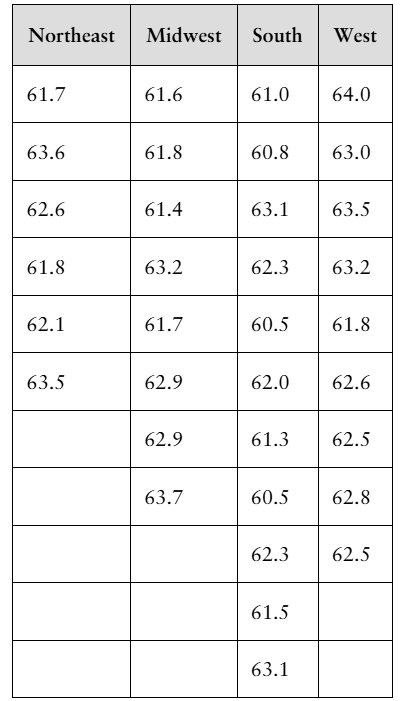
[APPLET] Well-Being Index The well-being index is a way to measure how people are faring physically, emotionally, socially, and professionally, as well as to rate the overall quality of their lives and their outlooks for the future. The table shows the well-being index scores for a sample of states from four regions of the United States. At α=0.10, can you reject the claim that the mean score is the same for all regions? (Adapted from Gallup and Healthways)


Verified step by step guidance
1
Step 1: Identify the claim and state the hypotheses. The claim is that the mean well-being index scores are the same for all four regions. Formally, the null hypothesis (H0) is that μ_Northeast = μ_Midwest = μ_South = μ_West, and the alternative hypothesis (Ha) is that at least one mean is different.
Step 2: Determine the significance level and find the critical value. The significance level α is given as 0.10. Since this is a one-way ANOVA test with 4 groups, calculate the degrees of freedom between groups (df_between = k - 1, where k is the number of groups) and within groups (df_within = N - k, where N is the total number of observations). Use an F-distribution table or software to find the critical value F_critical corresponding to α = 0.10, df_between, and df_within.
Step 3: Calculate the test statistic F. First, compute the group means and the overall mean. Then calculate the Sum of Squares Between (SSB) and Sum of Squares Within (SSW). Use these to find the Mean Square Between (MSB = SSB/df_between) and Mean Square Within (MSW = SSW/df_within). Finally, compute the test statistic F = MSB / MSW.
Step 4: Compare the test statistic F to the critical value F_critical. If F is greater than F_critical, reject the null hypothesis; otherwise, fail to reject the null hypothesis.
Step 5: Interpret the decision in context. If you reject H0, conclude that there is sufficient evidence at the 0.10 significance level to say that the mean well-being index scores differ among the regions. If you fail to reject H0, conclude that there is not sufficient evidence to say the means differ.

Verified video answer for a similar problem:

This video solution was recommended by our tutors as helpful for the problem above.
Video duration:
6m
Was this helpful?

Key Concepts

Here are the essential concepts you must grasp in order to answer the question correctly.

One-Way ANOVA Test

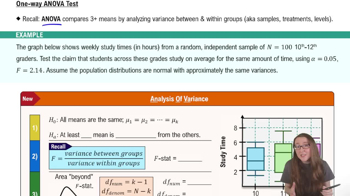
One-Way ANOVA (Analysis of Variance) is a statistical method used to compare the means of three or more independent groups to determine if at least one group mean is significantly different. It tests the null hypothesis that all group means are equal against the alternative that at least one differs. This method assumes normality, independence, and equal variances across groups.
Recommended video:
05:31
ANOVA Test

Hypothesis Testing and Rejection Region

Hypothesis testing involves stating a null hypothesis (H0) and an alternative hypothesis (Ha), then using sample data to decide whether to reject H0. The rejection region is determined by the critical value, which depends on the significance level (α). If the test statistic falls into this region, H0 is rejected, indicating evidence for Ha.
Recommended video:
05:52
Performing Hypothesis Tests: Proportions

F-Statistic and Critical Value in ANOVA

The F-statistic in ANOVA measures the ratio of variance between group means to variance within groups. A larger F-value suggests greater differences among group means. The critical value is obtained from the F-distribution table based on degrees of freedom and α. Comparing the F-statistic to the critical value helps decide whether to reject the null hypothesis.
Recommended video:
05:50
Critical Values: t-Distribution
Related Practice
Textbook Question

"Performing a Two-Sample F-Test In Exercises 19–26, (a) identify the claim and state H0 and Ha, (b) find the critical value and identify the rejection region, (c) find the test statistic F, (d) decide whether to reject or fail to reject the null hypothesis, and (e) interpret the decision in the context of the original claim. Assume the samples are random and independent, and the populations are normally distributed.


Carbon Monoxide Emissions An automobile manufacturer claims that the variance of the carbon monoxide emissions for a make and model of one of its vehicles is less than the variance of the carbon monoxide emissions for a top competitor’s equivalent vehicle. A sample of the carbon monoxide emissions of 19 of the manufacturer’s specified vehicles has a variance of 0.008. A sample of the carbon monoxide emissions of 21 of its competitor’s equivalent vehicles has a variance of 0.045. At α=0.10, can you support the manufacturer’s claim? (Adapted from U.S. Environmental Protection Agency)"

Textbook Question

"Performing a Two-Sample F-Test In Exercises 19–26, (a) identify the claim and state H0 and Ha, (b) find the critical value and identify the rejection region, (c) find the test statistic F, (d) decide whether to reject or fail to reject the null hypothesis, and (e) interpret the decision in the context of the original claim. Assume the samples are random and independent, and the populations are normally distributed.


Life of Appliances Company A claims that the variance of the lives of its appliances is less than the variance of the lives of Company B’s appliances. A sample of the lives of 20 of Company A’s appliances has a variance of 1.8. A sample of the lives of 25 of Company B’s appliances has a variance of 3.9. At α=0.025, can you support Company A’s claim?"

Textbook Question

Finding a Critical F-Value for a Two-Tailed Test In Exercises 9–12, find the critical F-value for a two-tailed test using the level of significance α and degrees of freedom d.f.N and d.f.D.


α=0.01, d.f.N=6, d.f.D=7

Textbook Question

Finding Expected Frequencies

In Exercises 7–12, (a) calculate the marginal frequencies and (b) find the expected frequency for each cell in the contingency table. Assume that the variables are independent.


Textbook Question

Performing a Chi-Square Independence Test In Exercises 13–28, perform the indicated chi-square independence test by performing the steps below.

a. Identify the claim and state H₀ and Hₐ


b. Determine the degrees of freedom, find the critical value, and identify the rejection region.


c. Find the chi-square test statistic.


d. Decide whether to reject or fail to reject the null hypothesis.


e. Interpret the decision in the context of the original claim.


Use the contingency table and expected frequencies from Exercise 10. At α=0.01, test the hypothesis that the variables are dependent.

Textbook Question

Performing a Chi-Square Goodness-of-Fit Test

In Exercises 7–16, (e) interpret the decision in the context of the original claim.


Ways to Pay A financial analyst claims that the distribution of people’s preferences on how to pay for goods is different from the distribution shown in the figure. You randomly select 600 people and record their preferences on how to pay for goods. The table shows the results. At α=0.01, test the financial analyst’s claim. (Adapted from Travis Credit Union)