
Ch. 10 - Chi-Square Tests and the F-Distribution
Larson - Elementary Statistics: Picturing the World 8th Edition
Larson8th EditionElementary Statistics: Picturing the WorldISBN: 9780137493470Not the one you use?Change textbook
Chapter 10, Problem 10.2.24

Performing a Chi-Square Independence Test In Exercises 13–28, perform the indicated chi-square independence test by performing the steps below.
a. Identify the claim and state H₀ and Hₐ


b. Determine the degrees of freedom, find the critical value, and identify the rejection region.


c. Find the chi-square test statistic.


d. Decide whether to reject or fail to reject the null hypothesis.


e. Interpret the decision in the context of the original claim.


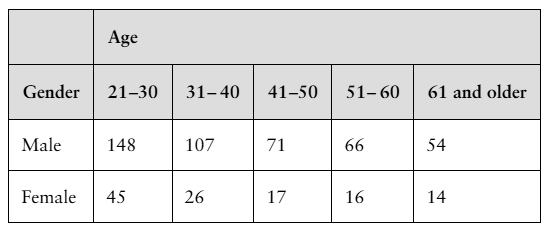
Alcohol-Related Accidents The contingency table shows the results of a random sample of fatally injured passenger vehicle drivers (with blood alcohol concentrations greater than or equal to 0.08) by age and gender. At α=0.05, can you conclude that age is related to gender in such alcohol-related accidents? (Adapted from Insurance Institute for Highway Safety)

Verified step by step guidance
1
Step 1: Identify the claim and state the null hypothesis (H₀) and alternative hypothesis (Hₐ). The claim is that age is related to gender in alcohol-related accidents. The null hypothesis (H₀) states that age and gender are independent, while the alternative hypothesis (Hₐ) states that age and gender are not independent.
Step 2: Determine the degrees of freedom (df), find the critical value, and identify the rejection region. Degrees of freedom are calculated using the formula: df = (number of rows - 1) × (number of columns - 1). For this table, there are 2 rows (Male, Female) and 5 columns (age groups), so df = (2 - 1) × (5 - 1) = 4. Using α = 0.05, find the critical value from the chi-square distribution table for df = 4. The rejection region is where the test statistic exceeds the critical value.
Step 3: Calculate the expected frequencies for each cell in the contingency table using the formula: Expected frequency = (row total × column total) / grand total. For example, for the cell corresponding to Male and age 21–30, calculate: Expected frequency = (row total for Male × column total for age 21–30) / grand total. Repeat this for all cells in the table.
Step 4: Compute the chi-square test statistic using the formula: χ² = Σ((Observed frequency - Expected frequency)² / Expected frequency). For each cell, subtract the expected frequency from the observed frequency, square the result, divide by the expected frequency, and sum these values across all cells.
Step 5: Compare the calculated chi-square test statistic to the critical value. If the test statistic exceeds the critical value, reject the null hypothesis (H₀). Otherwise, fail to reject the null hypothesis. Interpret the decision in the context of the original claim: If H₀ is rejected, conclude that age is related to gender in alcohol-related accidents; if H₀ is not rejected, conclude that there is insufficient evidence to support the claim.

Verified video answer for a similar problem:

This video solution was recommended by our tutors as helpful for the problem above.
Video duration:
5m
Was this helpful?

Key Concepts

Here are the essential concepts you must grasp in order to answer the question correctly.

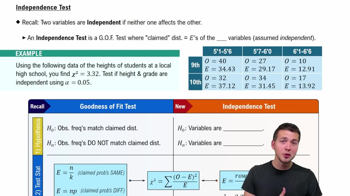
Chi-Square Independence Test

The Chi-Square Independence Test is a statistical method used to determine if there is a significant association between two categorical variables. It compares the observed frequencies in each category of a contingency table to the frequencies expected if the variables were independent. A significant result indicates that the variables are related, while a non-significant result suggests independence.
Recommended video:
Guided course
06:28
Independence Test

Null and Alternative Hypotheses

In hypothesis testing, the null hypothesis (H₀) represents the default position that there is no effect or relationship between the variables being studied. The alternative hypothesis (Hₐ) posits that there is a significant effect or relationship. In the context of the Chi-Square test, H₀ would state that age and gender are independent, while Hₐ would suggest that they are related.
Recommended video:
Guided course
06:21
Step 1: Write Hypotheses

Degrees of Freedom and Critical Value

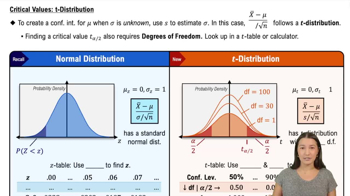
Degrees of freedom in a Chi-Square test are calculated based on the number of categories in the variables being analyzed, typically as (rows - 1) * (columns - 1). The critical value is a threshold that determines the rejection region for the null hypothesis. If the calculated Chi-Square statistic exceeds the critical value at a specified significance level (e.g., α=0.05), the null hypothesis is rejected, indicating a significant relationship between the variables.
Recommended video:
05:50
Critical Values: t-Distribution