Ch. 10 - Chi-Square Tests and the F-Distribution
Larson - Elementary Statistics: Picturing the World 8th Edition
Larson8th EditionElementary Statistics: Picturing the WorldISBN: 9780137493470Not the one you use?Change textbook
Chapter 10, Problem 10.2.20

Performing a Chi-Square Independence Test In Exercises 13–28, perform the indicated chi-square independence test by performing the steps below.
a. Identify the claim and state H₀ and Hₐ


b. Determine the degrees of freedom, find the critical value, and identify the rejection region.


c. Find the chi-square test statistic.


d. Decide whether to reject or fail to reject the null hypothesis.


e. Interpret the decision in the context of the original claim.


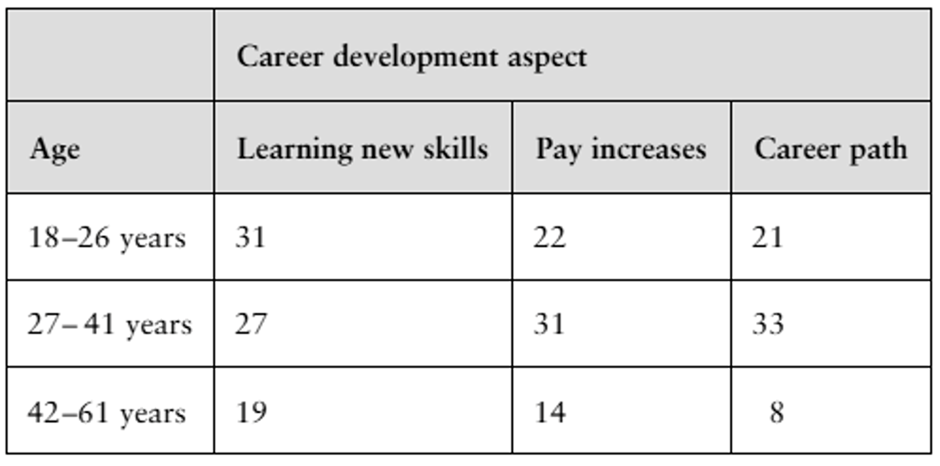
Ages and Goals You are investigating the relationship between the ages of U.S. adults and what aspect of career development they consider to be the most important. You randomly collect the data shown in the contingency table. At α=0.10, is there enough evidence to conclude that age is related to which aspect of career development is considered to be most important? (Adapted from The Harris Poll)


Contingency table showing U.S. adults' age and their prioritized career development aspects.

Verified step by step guidance
1
Step 1: Identify the claim and state the null hypothesis (H₀) and alternative hypothesis (Hₐ). The claim is that age is related to the aspect of career development considered most important. H₀: Age is not related to the aspect of career development considered most important (independence). Hₐ: Age is related to the aspect of career development considered most important (dependence).
Step 2: Determine the degrees of freedom (df), find the critical value, and identify the rejection region. Degrees of freedom are calculated using the formula df = (number of rows - 1) × (number of columns - 1). Here, there are 3 rows (age groups) and 3 columns (career development aspects), so df = (3 - 1) × (3 - 1) = 4. Using α = 0.10, find the critical value from the chi-square distribution table corresponding to df = 4. The rejection region is where the test statistic exceeds the critical value.
Step 3: Calculate the expected frequencies for each cell in the contingency table using the formula E = (row total × column total) / grand total. For example, for the cell corresponding to '18–26 years' and 'Learning new skills', calculate E = (row total for 18–26 years × column total for Learning new skills) / grand total. Repeat this for all cells in the table.
Step 4: Compute the chi-square test statistic using the formula χ² = Σ((O - E)² / E), where O represents the observed frequency and E represents the expected frequency for each cell. Sum the values for all cells to obtain the test statistic.
Step 5: Compare the calculated chi-square test statistic to the critical value. If the test statistic exceeds the critical value, reject the null hypothesis (H₀). Otherwise, fail to reject H₀. Interpret the decision in the context of the original claim: If H₀ is rejected, conclude that there is enough evidence to suggest that age is related to the aspect of career development considered most important. If H₀ is not rejected, conclude that there is not enough evidence to support the claim.

Verified video answer for a similar problem:

This video solution was recommended by our tutors as helpful for the problem above.
Video duration:
5m
Was this helpful?

Key Concepts

Here are the essential concepts you must grasp in order to answer the question correctly.

Chi-Square Independence Test

The Chi-Square Independence Test is a statistical method used to determine if there is a significant association between two categorical variables. It compares the observed frequencies in each category of a contingency table to the frequencies expected if the variables were independent. A significant result indicates that the variables are related, while a non-significant result suggests independence.
Recommended video:
Guided course
06:28
Independence Test

Null and Alternative Hypotheses (H₀ and Hₐ)

In hypothesis testing, the null hypothesis (H₀) represents the default position that there is no effect or relationship between the variables being studied. The alternative hypothesis (Hₐ) posits that there is a significant effect or relationship. In the context of the Chi-Square test, H₀ would state that age and career development aspects are independent, while Hₐ would suggest they are related.
Recommended video:
Guided course
06:21
Step 1: Write Hypotheses

Degrees of Freedom and Critical Value

Degrees of freedom in a Chi-Square test are calculated based on the number of categories in the variables being analyzed, typically as (rows - 1) * (columns - 1). The critical value is a threshold that determines the rejection region for the null hypothesis. If the calculated Chi-Square statistic exceeds the critical value at a specified significance level (e.g., α=0.10), the null hypothesis is rejected, indicating a significant relationship between the variables.
Recommended video:
05:50
Critical Values: t-Distribution
Related Practice
Textbook Question

What conditions are necessary in order to use a one-way ANOVA test?

Textbook Question

Explain why the chi-square independence test is always a right-tailed test.

Textbook Question

Performing a One-Way ANOVA Test In Exercises 5–14, (a) identify the claim and state H0 and Ha, (b) find the critical value and identify the rejection region, (c) find the test statistic F, (d) decide whether to reject or fail to reject the null hypothesis, and (e) interpret the decision in the context of the original claim. Assume the samples are random and independent, the populations are normally distributed, and the population variances are equal.


[APPLET] Statistician Salaries The table shows the salaries of a sample of entry level statisticians from six large metropolitan areas. At α=0.05, can you conclude that the mean salary is different in at least one of the areas? (Adapted from Salary.com)


Textbook Question

"Finding Left-Tailed Critical F-Values In this section, you only needed to calculate the right-tailed critical F-value for a two-tailed test. For other applications of the F-distribution, you will need to calculate the left-tailed critical F-value. To calculate the left-tailed critical F-value, perform the steps below.


1. Interchange the values for d.f.N and d.f.D.

2. Find the corresponding F-value in Table 7.

3. Calculate the reciprocal of the F-value to obtain the left-tailed critical F-value.


In Exercises 27 and 28, find the right- and left-tailed critical F-values for a two-tailed test using the level of significance α and degrees of freedom d.f.N and d.f.D.


α=0.10, d.f.N=20, d.f.D=15"

Textbook Question

Finding Expected Frequencies

In Exercises 3–6, find the expected frequency for the values of n and pᵢ.


n=500, pᵢ=0.9

Textbook Question

Finding a Critical F-Value for a Right-Tailed Test In Exercises 5–8, find the critical F-value for a right-tailed test using the level of significance α and degrees of freedom d.f.N and d.f.D.


α=0.10, d.f.N=10, d.f.D=15