


Ch. 10 - Chi-Square Tests and the F-Distribution
Larson - Elementary Statistics: Picturing the World 8th Edition
Larson8th EditionElementary Statistics: Picturing the WorldISBN: 9780137493470Not the one you use?Change textbook
Chapter 10, Problem 10.1.12

Performing a Chi-Square Goodness-of-Fit Test
In Exercises 7–16, (a) identify the claim and state H₀ and Hₐ, (b) find the critical value and identify the rejection region, (c) find the chi-square test statistic, (d) decide whether to reject or fail to reject the null hypothesis, and (e) interpret the decision in the context of the original claim.


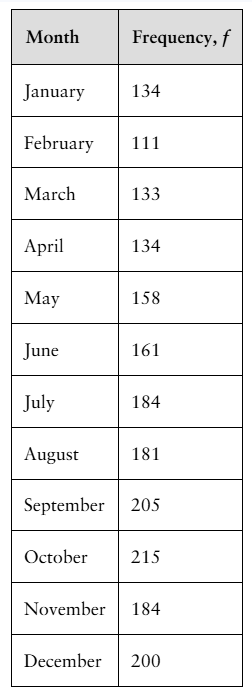
Homicides by Month A researcher claims that the number of homicide crimes in California by month is uniformly distributed. To test this claim, you randomly select 2000 homicides from a recent year and record the month when each happened. The table shows the results. At α=0.10, test the researcher’s claim. (Adapted from California Department of Justice)


Verified step by step guidance
1
Step 1: Identify the claim and state the null hypothesis (H₀) and the alternative hypothesis (Hₐ). The claim is that the number of homicides is uniformly distributed across all months. H₀: The distribution of homicides is uniform across months. Hₐ: The distribution of homicides is not uniform across months.
Step 2: Calculate the expected frequency for each month under the assumption of uniform distribution. Since there are 2000 total homicides and 12 months, the expected frequency for each month is calculated as: 200012. This gives the expected frequency for each month.
Step 3: Compute the chi-square test statistic using the formula: ((O-E)2E), where O is the observed frequency and E is the expected frequency. For each month, calculate the squared difference between observed and expected frequencies, divide by the expected frequency, and sum these values across all months.
Step 4: Determine the critical value and rejection region. The degrees of freedom (df) for this test are calculated as: df=n-1, where n is the number of categories (months). Use the chi-square distribution table to find the critical value at α=0.10 and df=11. The rejection region is where the test statistic exceeds the critical value.
Step 5: Compare the test statistic to the critical value. If the test statistic falls in the rejection region, reject H₀; otherwise, fail to reject H₀. Interpret the decision in the context of the original claim: If H₀ is rejected, conclude that the distribution of homicides is not uniform across months. If H₀ is not rejected, conclude that the data supports the claim of uniform distribution.

Verified video answer for a similar problem:

This video solution was recommended by our tutors as helpful for the problem above.
Video duration:
8m
Was this helpful?

Key Concepts

Here are the essential concepts you must grasp in order to answer the question correctly.

Chi-Square Goodness-of-Fit Test

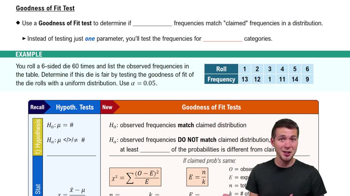
The Chi-Square Goodness-of-Fit Test is a statistical method used to determine if a sample distribution matches an expected distribution. In this context, it tests whether the observed frequencies of homicides across months differ significantly from what would be expected if they were uniformly distributed. The test compares the observed counts to the expected counts, calculating a chi-square statistic to assess the fit.
Recommended video:
Guided course
10:17
Goodness of Fit Test

Null and Alternative Hypotheses (H₀ and Hₐ)

In hypothesis testing, the null hypothesis (H₀) represents a statement of no effect or no difference, while the alternative hypothesis (Hₐ) represents what the researcher aims to prove. For this question, H₀ would state that the number of homicides is uniformly distributed across months, while Hₐ would claim that the distribution is not uniform. Formulating these hypotheses is crucial for conducting the test.
Recommended video:
Guided course
06:21
Step 1: Write Hypotheses

Critical Value and Rejection Region

The critical value is a threshold that determines the boundary for rejecting the null hypothesis in a statistical test. It is derived from the significance level (α), which in this case is 0.10. The rejection region is the range of values for the test statistic that would lead to rejecting H₀. Understanding how to find the critical value and define the rejection region is essential for making a decision based on the chi-square test results.
Recommended video:
05:50
Critical Values: t-Distribution
Related Practice
Textbook Question

In each exercise,

c. find the test statistic,

[APPLET] In Exercises 3 and 4, use the data, which list the annual wages (in thousands of dollars) for randomly selected individuals from three metropolitan areas. Assume the wages are normally distributed and that the samples are independent. (Adapted from U.S. Bureau of Economic Analysis)

Ithaca, NY: 53.0, 60.3, 34.6, 37.1, 46.6, 46.8, 41.4, 50.6, 50.8, 49.4, 35.0, 36.7, 57.1

Little Rock, AR: 50.7, 43.7, 53.4, 40.0, 45.2, 52.7, 35.2, 60.4, 40.0, 45.9, 45.7, 47.3, 46.5, 44.5, 31.5

Madison, WI: 62.4, 53.9, 67.6, 52.9, 67.7, 50.7, 62.1, 58.9, 61.1, 65.0, 60.4, 59.6, 51.3, 44.8, 66.2

Are the mean annual wages the same for all three cities? Use α=0.10. Assume that the population variances are equal.

1
views
Textbook Question

"Finding a Critical F-Value for a Right-Tailed Test In Exercises 5–8, find the critical F-value for a right-tailed test using the level of significance α and degrees of freedom d.f.N and d.f.D.


α=0.025, d.f.N=7, d.f.D=3"

Textbook Question

Testing for Normality Using a chi-square goodness-of-fit test, you can decide, with some degree of certainty, whether a variable is normally distributed. In all chi-square tests for normality, the null and alternative hypotheses are as listed below.


H₀: The variable has a normal distribution.


Hₐ: The variable does not have a normal distribution.


To determine the expected frequencies when performing a chi-square test for normality, first estimate the mean and standard deviation of the frequency distribution. Then, use the mean and standard deviation to compute the z-score for each class boundary. Then, use the z-scores to calculate the area under the standard normal curve for each class. Multiplying the resulting class areas by the sample size yields the expected frequency for each class.In Exercises 17 and 18, (a) find the expected frequencies, (b) find the critical value and identify the rejection region, (c) find the chi-square test statistic, (d) decide whether to reject or fail to reject the null hypothesis, and (e) interpret the decision in the context of the original claim.


In Exercises 17 and 18, (a) find the expected frequencies, (b) find the critical value and identify the rejection region, (c) find the chi-square test statistic, (d) decide whether to reject or fail to reject the null hypothesis, and (e) interpret the decision in the context of the original claim.


Test Scores At α=0.05, test the claim that the 400 test scores shown in the frequency distribution are normally distributed.


Textbook Question

Performing a Chi-Square Independence Test In Exercises 13–28, perform the indicated chi-square independence test by performing the steps below.

a. Identify the claim and state H₀ and Hₐ


b. Determine the degrees of freedom, find the critical value, and identify the rejection region.


c. Find the chi-square test statistic.


d. Decide whether to reject or fail to reject the null hypothesis.


e. Interpret the decision in the context of the original claim.


Choosing a College The contingency table shows the results of a survey asking 1858 parents and students of different incomes what their deciding factor was in choosing a college. At α=0.01, can you conclude that the deciding factor in choosing a college is related to the income of the family? (Adapted from Sallie Mae)


Textbook Question

In each exercise,

b. find the critical value and identify the rejection region,


In Exercises 1 and 2, use the table, which lists the distribution of educational achievement for people in the United States ages 25 and older. It also lists the results of a random survey for two additional age groups. (Adapted from U.S. Census Bureau)


Use the data for 30- to 34-year-olds and 65- to 69-year-olds to test whether age and educational attainment are related. Use α=0.01.

1
views
1
rank
Textbook Question

In each exercise,

d. decide whether to reject or fail to reject the null hypothesis, and

e. interpret the decision in the context of the original claim.


In Exercises 1 and 2, use the table, which lists the distribution of educational achievement for people in the United States ages 25 and older. It also lists the results of a random survey for two additional age groups. (Adapted from U.S. Census Bureau)


Use the data for 30- to 34-year-olds and 65- to 69-year-olds to test whether age and educational attainment are related. Use α=0.01.