
Ch. 10 - Chi-Square Tests and the F-Distribution
Larson - Elementary Statistics: Picturing the World 8th Edition
Larson8th EditionElementary Statistics: Picturing the WorldISBN: 9780137493470Not the one you use?Change textbook
Chapter 10, Problem 10.RE.15

In Exercises 13–16, find the critical F-value for a two-tailed test using the level of significance α and degrees of freedom d.f.N and d.f.D.


α=0.01,d.f.N=40,d.f.D=60

Verified step by step guidance
1
Step 1: Understand the problem. You are tasked with finding the critical F-value for a two-tailed test using the given level of significance (α = 0.01) and degrees of freedom for the numerator (d.f.N = 40) and denominator (d.f.D = 60). The critical F-value is used in hypothesis testing to determine the rejection region for the null hypothesis.
Step 2: Recognize that the F-distribution is not symmetric, and the critical values depend on the degrees of freedom for the numerator and denominator. For a two-tailed test, you will need to find the critical F-value for both tails (upper and lower).
Step 3: Use an F-distribution table or statistical software to locate the critical F-value. In the table, find the row corresponding to d.f.N = 40 and the column corresponding to d.f.D = 60. Since α = 0.01 for a two-tailed test, divide α by 2 to allocate 0.005 to each tail.
Step 4: For the upper tail, locate the critical F-value corresponding to α = 0.005, d.f.N = 40, and d.f.D = 60. For the lower tail, calculate the reciprocal of the upper tail critical F-value because the F-distribution is asymmetric.
Step 5: Summarize the results. The critical F-values for the two-tailed test are the values found in Step 4 for the upper and lower tails. These values define the rejection region for the null hypothesis in the F-test.

Verified video answer for a similar problem:

This video solution was recommended by our tutors as helpful for the problem above.
Video duration:
3m
Was this helpful?

Key Concepts

Here are the essential concepts you must grasp in order to answer the question correctly.

Critical F-value

The critical F-value is a threshold used in hypothesis testing to determine whether to reject the null hypothesis. It is derived from the F-distribution, which is used when comparing variances between two groups. The critical value is based on the chosen significance level (α) and the degrees of freedom for the numerator (d.f.N) and denominator (d.f.D). If the calculated F-statistic exceeds this critical value, the null hypothesis is rejected.
Recommended video:
05:50
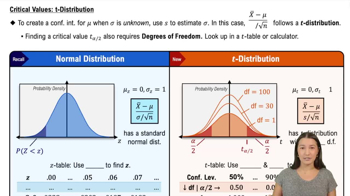
Critical Values: t-Distribution

Degrees of Freedom

Degrees of freedom (d.f.) refer to the number of independent values or quantities that can vary in an analysis without violating any constraints. In the context of an F-test, d.f.N represents the degrees of freedom associated with the numerator (the group with more variability), while d.f.D represents the degrees of freedom for the denominator (the group with less variability). These values are crucial for determining the shape of the F-distribution and finding the critical F-value.
Recommended video:
05:50
Critical Values: t-Distribution

Level of Significance (α)

The level of significance (α) is the probability of rejecting the null hypothesis when it is actually true, also known as a Type I error. It is a threshold set by the researcher, commonly at 0.05 or 0.01, which indicates the risk level they are willing to accept for making a false positive conclusion. In this question, α is set at 0.01, meaning there is a 1% risk of incorrectly rejecting the null hypothesis.
Recommended video:
03:33
Finding Binomial Probabilities Using TI-84 Example 1
Related Practice
Textbook Question

In each exercise,

e. interpret the decision in the context of the original claim.

[APPLET] In Exercises 1–3, use the data, which list the hourly wages (in dollars) for randomly selected surgical technologists from three states. Assume the wages are normally distributed and that the samples are independent. (Adapted from U.S. Bureau of Labor Statistics)

Maine: 22.76, 27.60, 25.08, 17.01, 30.15, 27.09, 20.95, 25.52, 20.11, 23.67, 24.32

Oklahoma: 24.64, 21.66, 19.38, 18.19, 23.14, 20.58, 19.53, 30.77, 27.46, 23.80

Massachusetts: 27.07, 24.71, 32.80, 28.34, 33.45, 33.36, 36.81, 30.04, 29.01, 24.30, 29.22, 29.50

Are the mean hourly wages of surgical technologists the same for all three states? Use α=0.01. Assume that the population variances are equal.

1
views
Textbook Question

In Exercises 9–12, find the critical F-value for a right-tailed test using the level of significance α and degrees of freedom d.f.N and d.f.D.


α=0.05,d.f.N=20,d.f.D=25

1
views
Textbook Question

In Exercises 13–16, find the critical F-value for a two-tailed test using the level of significance α and degrees of freedom d.f.N and d.f.D.


α=0.01,d.f.N=11,d.f.D=13

1
views
Textbook Question

In each exercise,

d. decide whether to reject or fail to reject the null hypothesis, and

[APPLET] In Exercises 1–3, use the data, which list the hourly wages (in dollars) for randomly selected surgical technologists from three states. Assume the wages are normally distributed and that the samples are independent. (Adapted from U.S. Bureau of Labor Statistics)

Maine: 22.76, 27.60, 25.08, 17.01, 30.15, 27.09, 20.95, 25.52, 20.11, 23.67, 24.32

Oklahoma: 24.64, 21.66, 19.38, 18.19, 23.14, 20.58, 19.53, 30.77, 27.46, 23.80

Massachusetts: 27.07, 24.71, 32.80, 28.34, 33.45, 33.36, 36.81, 30.04, 29.01, 24.30, 29.22, 29.50

Are the mean hourly wages of surgical technologists the same for all three states? Use α=0.01. Assume that the population variances are equal.

1
views
Textbook Question

In Exercises 1–4, (a) identify the claim and state H₀ and Hₐ, (b) find the critical value and identify the rejection region, (c) find the chi-square test statistic, (d) decide whether to reject or fail to reject the null hypothesis, and (e) interpret the decision in the context of the original claim.


A sports website claims that the opinions of golfers about what irritates them the most on the golf course are distributed as shown in the pie chart. You randomly select 1018 golfers and ask them what irritates them the most on the golf course. The table shows the results. At α=0.05, test the sports website’s claim. (Adapted from GOLF.com)


Textbook Question

In Exercises 5–8, (a) find the expected frequency for each cell in the contingency table, (b) identify the claim and state H0 and Ha, (c) determine the degrees of freedom, find the critical value, and identify the rejection region, (d) find the chi-square test statistic, (e) decide whether to reject or fail to reject the null hypothesis, and (f) interpret the decision in the context of the original claim.


The contingency table shows the distribution of a random sample of fatal pedestrian and bicyclist motor vehicle collisions by time of day in a recent year. At α=0.10, can you conclude that the type of crash victim and the time of day are related? (Adapted from National Highway Traffic Safety Administration)