Ch. 1 - Introduction to Statistics
Larson - Elementary Statistics: Picturing the World 8th Edition
Larson8th EditionElementary Statistics: Picturing the WorldISBN: 9780137493470Not the one you use?Change textbook
Chapter 1, Problem 1.2.17

Determine the level of measurement of the data set. Explain your reasoning.
The lengths (in centimeters) of 22 Ford automobiles are listed. (Source: Automobiledimension.com)
404 407 410 416 421 438 440 443 461 467 471 478 480 483 483 485 487 487 497 505 534 536

Verified step by step guidance
1
Identify the four levels of measurement in statistics: nominal, ordinal, interval, and ratio. These levels determine how data can be analyzed and interpreted.
Examine the data set provided. The data consists of numerical values representing the lengths of Ford automobiles in centimeters.
Determine if the data has a true zero point. Since the lengths of automobiles cannot be negative and a length of 0 cm represents the absence of length, the data has a true zero point.
Assess whether the differences between the data values are meaningful. For example, the difference between 410 cm and 404 cm is 6 cm, which is a meaningful measurement of length.
Conclude that the data is measured at the ratio level because it is numerical, has a true zero point, and the differences and ratios between values are meaningful (e.g., a car that is 536 cm long is twice as long as a car that is 268 cm long).

Verified video answer for a similar problem:

This video solution was recommended by our tutors as helpful for the problem above.
Video duration:
5m
Was this helpful?

Key Concepts

Here are the essential concepts you must grasp in order to answer the question correctly.

Levels of Measurement

Levels of measurement refer to the different ways data can be categorized and quantified. There are four primary levels: nominal, ordinal, interval, and ratio. Each level has distinct characteristics, with ratio being the highest, allowing for meaningful comparisons and the presence of a true zero. Understanding these levels is crucial for determining appropriate statistical analyses.
Recommended video:
Guided course
10:28
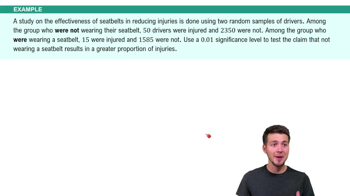
Difference in Proportions: Hypothesis Tests Example 1

Ratio Level Data

Ratio level data is a type of quantitative data that possesses all the properties of interval data, but also includes a true zero point, which allows for the comparison of absolute magnitudes. In the context of the lengths of Ford automobiles, the measurements in centimeters can be compared meaningfully, and a length of zero centimeters indicates the absence of length, making it a ratio level measurement.
Recommended video:
Guided course
04:39
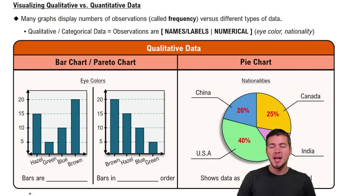
Visualizing Qualitative vs. Quantitative Data

Data Interpretation

Data interpretation involves analyzing and making sense of collected data to draw conclusions or inform decisions. In this case, interpreting the lengths of the Ford automobiles requires understanding the context of the measurements and recognizing that they represent continuous numerical data, which can be summarized using statistical measures such as mean, median, and range.
Recommended video:
Guided course
04:39
Visualizing Qualitative vs. Quantitative Data