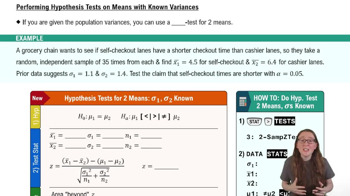
When performing a hypothesis test for two means with known population standard deviations, which type of test do you use?
You use a z-test instead of a t-test when the population standard deviations are known.
What is the main difference in the formula for the test statistic when using known population standard deviations?
The sample standard deviations in the denominator are replaced with the population standard deviations.
What is the null hypothesis when comparing two means in this context?
The null hypothesis is that the two population means are equal, or mu1 = mu2.
How do you determine the alternative hypothesis in a two means test?
The alternative hypothesis is based on the claim you are testing, such as mu1 < mu2 if you suspect the first mean is less than the second.
What information do you need from the problem to perform the z-test for two means?
You need the sample means, population standard deviations, and sample sizes for both groups.
How do you calculate the z-score for two means with known variances?
You use the difference in sample means divided by the square root of the sum of the population variances divided by their respective sample sizes.
What does the p-value represent in this hypothesis test?
The p-value is the probability of observing a test statistic as extreme as, or more extreme than, the one calculated, assuming the null hypothesis is true.
How do you decide whether to reject the null hypothesis in this test?
You reject the null hypothesis if the p-value is less than the significance level alpha.
What significance level (alpha) was used in the example provided?
The significance level used was 0.05.
What conclusion was drawn in the example about self checkout versus cashier lanes?
The test provided enough evidence to suggest that self checkout lanes have shorter times than cashier lanes.
What are the required conditions for performing this two means z-test?
You need independent random samples and either normal populations or both sample sizes greater than 30.
What technology was used in the example to perform the calculations?
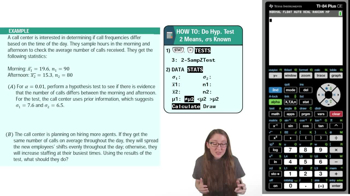
A TI-84 calculator was used to perform the two-sample z-test calculations.
What was the calculated z-score in the example?
The calculated z-score was approximately -6.31.
What was the approximate p-value found in the example?
The p-value was approximately 1.37 × 10⁻¹⁰.
Why is it important to check the criteria for the test after performing the hypothesis test?
Checking the criteria ensures the validity of the test results by confirming the assumptions are met.
 Back
Back

 02:44
02:44