Statistics
My Course
Learn
Exam Prep
AI Tutor
Study Guides
Textbook Solutions
Flashcards
Explore
Try the app
My Course
Learn
Exam Prep
AI Tutor
Study Guides
Textbook Solutions
Flashcards
Explore
Try the app
Back
Sampling Distribution of Sample Proportion definitions
You can tap to flip the card.
Binomial Distribution
You can tap to flip the card.
👆
Binomial Distribution
Probability model for discrete outcomes with fixed trials and two possible results, often used for success/failure scenarios.
Track progress
Control buttons has been changed to "navigation" mode.
1/15
Related flashcards
Related practice
Recommended videos
Sampling Distribution of Sample Proportion quiz #1
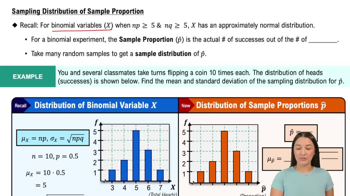
Sampling Distribution of Sample Proportion
24 Terms
Confidence Intervals for Population Proportion
8. Sampling Distributions & Confidence Intervals: Proportion
7 problems
Topic

Ernest
8. Sampling Distributions & Confidence Intervals: Proportion
1 topic
3 problems
Chapter
Ernest
05:11
Sampling Distribution of Sample Proportion
3
views
03:21
Using the Normal Distribution to Approximate Binomial Probabilities Example 1
2
views
06:23
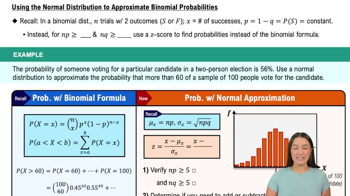
Using the Normal Distribution to Approximate Binomial Probabilities
3
views
Terms in this set (15)
Hide definitions
Binomial Distribution
Probability model for discrete outcomes with fixed trials and two possible results, often used for success/failure scenarios.
Normal Distribution
Bell-shaped curve used to approximate probabilities when sample size is large and certain conditions are met.
Sample Proportion
Ratio of observed successes to total trials in a sample, providing a measure of relative frequency.
Sampling Distribution
Graphical representation of a statistic's values from repeated random samples, showing its variability and shape.
Mean
Expected value of a distribution, indicating the central tendency of observed outcomes.
Standard Deviation
Measure of spread in a distribution, quantifying how much values typically differ from the mean.
Z Score
Standardized value indicating how many standard deviations a data point is from the mean.
Continuity Correction
Adjustment applied when approximating discrete distributions with continuous models, often by adding or subtracting 0.5.
Successes
Number of favorable outcomes in a set of trials, often used in binomial experiments.
Trials
Total number of attempts or observations in an experiment, forming the basis for probability calculations.
Probability
Likelihood of a specific outcome occurring, expressed as a value between 0 and 1.
Confidence Interval
Range of values estimated from sample data that likely contains the true population parameter.
Rescaled Axis
Modification of a graph's scale, such as dividing by total trials, to represent proportions instead of counts.
Population Parameter
Value describing a characteristic of the entire population, such as the true proportion or mean.
Cheat Sheet
Reference guide used to quickly determine adjustments or steps in statistical calculations.