Skip to main content
Statistics
My Course
Learn
Exam Prep
AI Tutor
Study Guides
Textbook Solutions
Flashcards
Explore
Try the app
My Course
Learn
Exam Prep
AI Tutor
Study Guides
Textbook Solutions
Flashcards
Explore
Try the app
Back
Regression Readout of the Data Analysis Toolpak - Excel quiz
You can tap to flip the card.
What is the first step to performing regression analysis using Excel's data analysis tool pack?
You can tap to flip the card.
👆
What is the first step to performing regression analysis using Excel's data analysis tool pack?
The first step is to click on the Data menu, select Data Analysis, choose Regression, and input your y and x data ranges.
Track progress
Control buttons has been changed to "navigation" mode.
1/15
Related flashcards
Related practice
Recommended videos
Regression Readout of the Data Analysis Toolpak - Excel definitions
Regression Readout of the Data Analysis Toolpak - Excel
15 Terms
Prediction Intervals
12. Regression
3 problems
Topic
12. Regression
6 topics
9 problems
Chapter
Justin
09:50
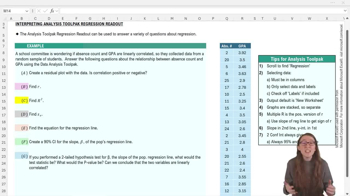
Regression Readout of the Data Analysis Toolpak - Excel
2
views
Terms in this set (15)
Hide definitions
What is the first step to performing regression analysis using Excel's data analysis tool pack?
The first step is to click on the Data menu, select Data Analysis, choose Regression, and input your y and x data ranges.
Why is it important to select data in columns when using the regression tool in Excel?
The tool pack requires vertical data tables; selecting data in columns ensures proper input and avoids errors.
What must you do if you include labels when selecting your data for regression in Excel?
You must check off the 'Labels' option in the regression menu to ensure Excel recognizes the labels.
How can you change the confidence level for the regression output in Excel?
You can manually enter your desired confidence level in the regression menu before running the analysis.
What does checking the 'Residual Plots' option in Excel's regression tool provide?
It generates a residual plot, which helps assess the fit of the linear model by showing the distribution of residuals.
What does the residual plot indicate if residuals are scattered with no clear pattern?
It suggests that the linear model is a good fit for the data.
How can you visually determine the direction of correlation in Excel's line fit plot?
By observing the plot, if y decreases as x increases, it indicates negative linear correlation.
Where do you find the correlation coefficient (r) in Excel's regression readout?
The correlation coefficient is found in the 'Multiple R' row of the output table.
Why must you manually add a negative sign to the correlation coefficient in some cases?
Excel always presents the magnitude as positive, so you must add a negative sign if the correlation is negative.
What does the coefficient of determination (R²) represent in regression analysis?
R² shows the percentage of variation in the y variable explained by variation in the x variable.
Where is the standard error found in the regression output, and what is its use?
It is found in the 'Standard Error' row and is used in calculations like prediction intervals.
How do you construct the regression line equation from Excel's output?
Use the intercept and slope coefficients from the 'Coefficients' column to form the equation y = slope*x + intercept.
Where do you find the 90% confidence interval for the slope in Excel's regression output?
The lower and upper bounds are in the 'Lower 90%' and 'Upper 90%' columns for the x variable row.
What is the test statistic for the slope in hypothesis testing, and where is it found?
The test statistic is a t-score, found in the 't Stat' column for the x variable row.
How do you determine if there is linear correlation using the p-value from regression output?
Compare the p-value to alpha; if p-value is less than alpha, reject the null hypothesis and conclude there is linear correlation.
 BackBack
 09:50
09:50