Skip to main content
Introductory Statistics
My Course
Learn
Exam Prep
AI Tutor
Study Guides
Textbook Solutions
Flashcards
Explore
Try the app
My Course
Learn
Exam Prep
AI Tutor
Study Guides
Textbook Solutions
Flashcards
Explore
Try the app
Back
Levels of Measurement quiz
You can tap to flip the card.
What are the four levels of measurement used to classify data?
You can tap to flip the card.
👆
What are the four levels of measurement used to classify data?
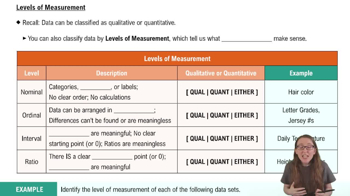
The four levels are nominal, ordinal, interval, and ratio.
Track progress
Control buttons has been changed to "navigation" mode.
1/15
Related flashcards
Related practice
Recommended videos
Levels of Measurement definitions
Levels of Measurement
15 Terms
Levels of Measurement
1. Intro to Stats and Collecting Data
5 problems
Topic
David-Paige
Intro to Collecting Data
1. Intro to Stats and Collecting Data
5 problems
Topic
Brendan
1. Intro to Stats and Collecting Data
4 topics
12 problems
Chapter
Brendan
Guided course
06:52
Levels of Measurement
6
views
Guided course
02:46
Levels of Measurement Example 1
4
views
Guided course
02:46
Levels of Measurement Example 2
5
views
Terms in this set (15)
Hide definitions
What are the four levels of measurement used to classify data?
The four levels are nominal, ordinal, interval, and ratio.
What type of data is classified as nominal?
Nominal data consists of categories, names, or labels without any inherent order.
Can you perform calculations like mean or difference on nominal data?
No, calculations such as mean or difference do not make sense for nominal data because it is qualitative.
What distinguishes ordinal data from nominal data?
Ordinal data can be arranged in a meaningful order, while nominal data cannot.
Why can't differences between ordinal data points always be found or make sense?
Because the intervals between ordinal data points are inconsistent or undefined.
Can ordinal data be qualitative or quantitative?
Yes, ordinal data can be either qualitative or quantitative.
What is a key feature of interval level data?
Interval data allows meaningful differences between data points but lacks a true zero.
Why are ratios meaningless in interval data?
Because there is no true zero, so multiplying or dividing values does not yield meaningful results.
Give an example of interval data and explain why it fits.
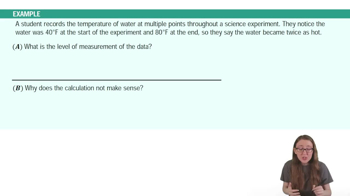
Temperature in Fahrenheit is interval data because differences are meaningful but there is no true zero.
What makes ratio level data unique compared to other levels?
Ratio data has a true zero, allowing for meaningful ratios and arithmetic operations.
Can you multiply and divide values in ratio level data?
Yes, because ratio data has a true zero, multiplication and division are meaningful.
Is working hours an example of ratio level data? Why or why not?
Yes, because working hours are quantitative, have a true zero, and allow meaningful differences and ratios.
Why are birth years considered interval data and not ratio?
Birth years have meaningful differences but lack a true zero, so ratios are not meaningful.
What level of measurement is used for satisfaction ratings on a scale from 1 to 5?
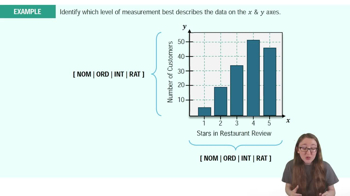
Satisfaction ratings are ordinal because they have a meaningful order but inconsistent differences.
Why is understanding levels of measurement important in statistics?
It guides which statistical calculations are appropriate and ensures correct application of descriptive and inferential statistics.
 BackBack
 06:52
06:52