Skip to main content
Introductory Statistics
My Course
Learn
Exam Prep
AI Tutor
Study Guides
Textbook Solutions
Flashcards
Explore
Try the app
My Course
Learn
Exam Prep
AI Tutor
Study Guides
Textbook Solutions
Flashcards
Explore
Try the app
Back
Intro to Stats definitions
You can tap to flip the card.
Statistics
You can tap to flip the card.
👆
Statistics
Branch of science focused on collecting and analyzing data to inform decisions about groups or entities.
Track progress
Control buttons has been changed to "navigation" mode.
1/13
Related flashcards
Related practice
Recommended videos
Intro to Stats quiz #1
Intro to Stats
28 Terms
Intro to Stats
1. Intro to Stats and Collecting Data
5 problems
Topic
Brendan
Levels of Measurement
1. Intro to Stats and Collecting Data
5 problems
Topic
David-Paige
1. Intro to Stats and Collecting Data
4 topics
12 problems
Chapter
Brendan
Guided course
04:24
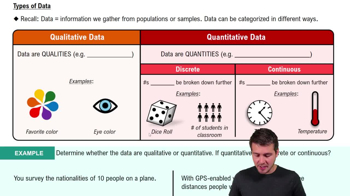
Types of Data
8
views
1
rank
Guided course
05:53
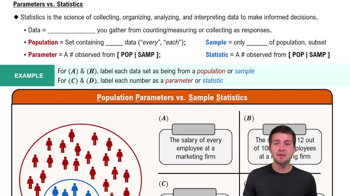
Parameters vs. Statistics
29
views
1
rank
Guided course
2:13
Introduction to Statistics Channel
21
views
2
rank
Terms in this set (13)
Hide definitions
Statistics
Branch of science focused on collecting and analyzing data to inform decisions about groups or entities.
Data
Information collected as measurements, counts, or responses, forming the basis for analysis and interpretation.
Population
Entire group of interest containing all relevant data, measurements, or responses for a specific study.
Sample
Subset of a population selected to represent and provide insights about the larger group.
Parameter
Numerical value summarizing a characteristic of a population, such as an average or proportion.
Statistic
Numerical value summarizing a characteristic of a sample, used to estimate population parameters.
Qualitative Data
Information categorized by names, labels, or attributes, lacking inherent numerical value for calculations.
Quantitative Data
Information expressed as numbers or measurements, suitable for mathematical operations and analysis.
Discrete Variable
Numerical data with countable values that cannot be subdivided, such as dice rolls or student counts.
Continuous Variable
Numerical data that can be divided into finer units, allowing for decimals and fractions, like time or distance.
Business Analytics
Application of statistical methods to interpret data and guide decision-making in commercial contexts.
Inferential Statistics
Techniques used to draw conclusions about populations based on sample data, often involving estimation or prediction.
Attribute
Characteristic or quality used to categorize qualitative data, such as eye color or nationality.
 BackBack
 04:24
04:24