Skip to main content
Statistics
My Course
Learn
Exam Prep
AI Tutor
Study Guides
Textbook Solutions
Flashcards
Explore
Try the app
My Course
Learn
Exam Prep
AI Tutor
Study Guides
Textbook Solutions
Flashcards
Explore
Try the app
Back
Discrete Random Variables definitions
You can tap to flip the card.
Random Variable
You can tap to flip the card.
👆
Random Variable
A symbol representing a value determined by chance for each outcome in an experiment.
Track progress
Control buttons has been changed to "navigation" mode.
1/15
Related flashcards
Related practice
Recommended videos
Discrete Random Variables quiz #1
Discrete Random Variables
20 Terms
Discrete Random Variables
5. Binomial Distribution & Discrete Random Variables
6 problems
Topic
Laura
Binomial Distribution
5. Binomial Distribution & Discrete Random Variables
7 problems
Topic
Ernest
5. Binomial Distribution & Discrete Random Variables
4 topics
12 problems
Chapter
Ernest
Guided course
04:14
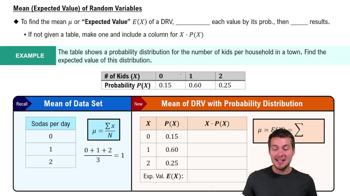
Expected Value (Mean) of Random Variables
2
views
Guided course
07:09
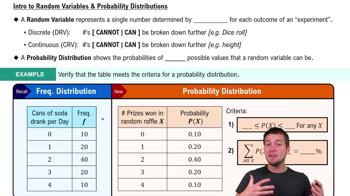
Intro to Random Variables & Probability Distributions
2
views
Guided course
04:48
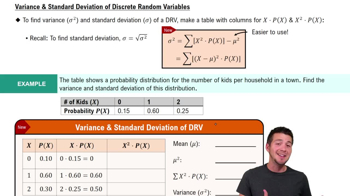
Variance & Standard Deviation of Discrete Random Variables
1
views
Terms in this set (15)
Hide definitions
Random Variable
A symbol representing a value determined by chance for each outcome in an experiment.
Discrete Random Variable
A variable with distinct, indivisible outcomes, such as whole numbers from a dice roll.
Continuous Random Variable
A variable with outcomes that can be broken down infinitely, covering all values within a range.
Probability Distribution
A table showing all possible values of a random variable and their associated probabilities.
Frequency Distribution
A summary listing outcomes and their observed frequencies after an experiment.
Outcome
A possible result from an experiment, represented as a value of a random variable.
Probability
A decimal between 0 and 1 indicating the likelihood of a specific outcome occurring.
Expected Value
A weighted average of all possible values, calculated using each value's probability.
Mean
A central value of a probability distribution, found by summing products of values and probabilities.
Variance
A measure of how spread out outcomes are, calculated by subtracting the mean squared from the sum of squared values times probabilities.
Standard Deviation
A value indicating the typical distance outcomes deviate from the mean, found by taking the square root of variance.
Sigma Notation
A mathematical symbol used to represent the sum of a series of terms, often in probability calculations.
Table
An organized arrangement of outcomes and probabilities, aiding calculation and visualization.
Experiment
A process or action resulting in random outcomes, forming the basis for probability analysis.
Criteria
Conditions required for a probability distribution, such as probabilities summing to one and each being between zero and one.
 BackBack

 04:14
04:14