Skip to main content
Introductory Statistics
My Course
Learn
Exam Prep
AI Tutor
Study Guides
Textbook Solutions
Flashcards
Explore
Try the app
My Course
Learn
Exam Prep
AI Tutor
Study Guides
Textbook Solutions
Flashcards
Explore
Try the app
Back
Complements quiz
You can tap to flip the card.
What is the complement of an event in probability?
You can tap to flip the card.
👆
What is the complement of an event in probability?
The complement of an event is all outcomes where the event does not occur.
Track progress
Control buttons has been changed to "navigation" mode.
1/15
Related flashcards
Related practice
Recommended videos
Complements definitions
Complements
15 Terms
Complements
4. Probability
4 problems
Topic
Ernest
Addition Rule
4. Probability
6 problems
Topic
Ernest
4. Probability - Part 1 of 3
3 topics
9 problems
Chapter
Ernest
4. Probability - Part 2 of 3
4 topics
12 problems
Chapter
Ernest
4. Probability - Part 3 of 3
2 topics
6 problems
Chapter
Ally
Guided course
4:23
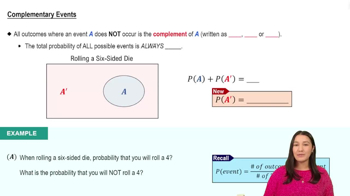
Complementary Events
5
views
Terms in this set (15)
Hide definitions
What is the complement of an event in probability?
The complement of an event is all outcomes where the event does not occur.
How is the probability of the complement of event A denoted?
It can be denoted as Ac, A', or sometimes with a line over A or a 'not' symbol.
What is the formula for the probability of the complement of event A?
The formula is P(Ac) = 1 − P(A).
If the probability of rolling a 4 on a six-sided die is 1/6, what is the probability of not rolling a 4?
The probability is 1 − 1/6 = 5/6.
Why do the probabilities of an event and its complement always add up to 1?
Because together they cover all possible outcomes, which is 100% of the possibilities.
How can you find the probability of an event not happening without counting all non-event outcomes?
Subtract the probability of the event from 1.
In a standard deck of 52 cards, what is the probability of not drawing a queen?
It is 1 − 4/52 = 48/52, or approximately 0.92.
What does the formula P(Ac) = 1 − P(A) help simplify?
It simplifies finding the probability of an event not occurring.
If P(A) = 0.3, what is P(Ac)?
P(Ac) = 1 − 0.3 = 0.7.
What is the probability of rolling any number except 4 on a six-sided die?
It is 5/6, since there are 5 outcomes that are not 4.
Why is it sometimes easier to calculate the probability of the complement rather than the event itself?
Because the complement may have fewer or easier-to-count outcomes.
What is the sum of the probability of an event and its complement?
The sum is always 1.
If there are 4 queens in a deck of 52 cards, how do you calculate the probability of not drawing a queen?
Subtract the probability of drawing a queen (4/52) from 1 to get 48/52.
What does the complement rule reflect about classical probability?
It reflects that all possible outcomes together have a total probability of 1.
How does using the complement help when asked for the probability that an event will not happen?
It allows you to use the known probability of the event to quickly find the probability of its non-occurrence.
 BackBack

 4:23
4:23