Statistics
My Course
Learn
Exam Prep
AI Tutor
Study Guides
Textbook Solutions
Flashcards
Explore
Try the app
My Course
Learn
Exam Prep
AI Tutor
Study Guides
Textbook Solutions
Flashcards
Explore
Try the app
Back
Addition Rule definitions
You can tap to flip the card.
Probability
You can tap to flip the card.
👆
Probability
A numerical measure expressing the likelihood of an event occurring, ranging from 0 (impossible) to 1 (certain).
Track progress
Control buttons has been changed to "navigation" mode.
1/15
Related flashcards
Related practice
Recommended videos
Addition Rule quiz #1
Addition Rule
10 Terms
Addition Rule
4. Probability
6 problems
Topic

Ernest
Multiplication Rule: Independent Events
4. Probability
5 problems
Topic
Ernest
4. Probability - Part 1 of 2
3 topics
9 problems
Chapter
Ernest
4. Probability - Part 2 of 2
3 topics
9 problems
Chapter
Ernest
5:14
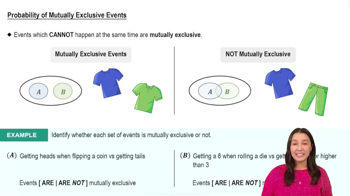
Probability of Mutually Exclusive Events
1
views
2:57
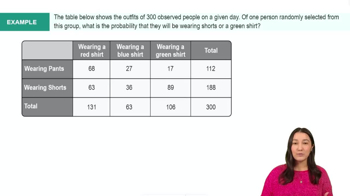
Probability of Non-Mutually Exclusive Events Example
5:14
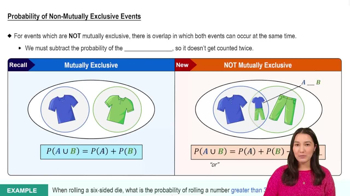
Probability of Non-Mutually Exclusive Events
1
views
Terms in this set (15)
Hide definitions
Probability
A numerical measure expressing the likelihood of an event occurring, ranging from 0 (impossible) to 1 (certain).
Event
A specific outcome or set of outcomes from a random experiment, such as rolling a die or flipping a coin.
Mutually Exclusive
A relationship between events where they cannot occur simultaneously; their overlap is always zero.
Non-Mutually Exclusive
A relationship between events where simultaneous occurrence is possible, resulting in an overlap region.
Overlap
The region in a diagram representing outcomes shared by two events, counted in both unless subtracted.
Circle Diagram
A visual tool using circles to illustrate relationships between events, highlighting exclusivity and overlap.
Set Notation
A symbolic system using U for 'or' and ∩ for 'and' to represent event relationships in probability.
Or Probability
The chance that at least one of two events occurs, calculated by combining their individual probabilities.
And Probability
The likelihood that two events occur together, represented by the overlap in diagrams and set notation.
Formula
A mathematical expression used to calculate probabilities, such as P(A or B) = P(A) + P(B) - P(A and B).
Outcome
A possible result from a random experiment, like rolling a specific number on a die.
Simplified Fraction
A reduced form of a probability ratio, making calculations and comparisons easier.
Decimal
A numerical representation of probability, often used for clarity and comparison.
Uncertainty
The inherent unpredictability in random experiments, addressed through probability calculations.
Statistical Analysis
A process involving probability concepts to interpret data and make informed decisions.