Ch. 10 - Correlation and Regression
Triola - Elementary Statistics 14th Edition
Triola14th EditionElementary StatisticsISBN: 9780137366446Not the one you use?Change textbook
Chapter 10, Problem 10.5.8

Finding the Best Model
In Exercises 5–16, construct a scatterplot and identify the mathematical model that best fits the given data. Assume that the model is to be used only for the scope of the given data, and consider only linear, quadratic, logarithmic, exponential, and power models.
Sound Intensity The table lists intensities of sounds as multiples of a basic reference sound. A scale similar to the decibel scale is used to measure the sound intensity.
Table displaying sound intensity values and their corresponding scale values.

Verified step by step guidance
1
Step 1: Begin by plotting a scatterplot of the given data. Use the 'Sound Intensity' values as the x-axis and the 'Scale Value' as the y-axis. This will help visualize the relationship between the two variables.
Step 2: Analyze the scatterplot to determine the general trend or pattern in the data. Look for whether the data points suggest a linear, quadratic, logarithmic, exponential, or power relationship.
Step 3: Fit different mathematical models to the data. For each model (linear, quadratic, logarithmic, exponential, and power), calculate the corresponding equation using regression techniques. For example, for a linear model, use the formula y = mx + b, where m is the slope and b is the y-intercept.
Step 4: Evaluate the goodness-of-fit for each model using statistical measures such as the coefficient of determination (R²). The model with the highest R² value is typically the best fit for the data.
Step 5: Once the best-fitting model is identified, ensure that the model is appropriate for the scope of the given data. Interpret the model in the context of the problem, and confirm that it aligns with the observed trend in the scatterplot.

Verified video answer for a similar problem:

This video solution was recommended by our tutors as helpful for the problem above.
Video duration:
3m
Was this helpful?

Key Concepts

Here are the essential concepts you must grasp in order to answer the question correctly.

Scatterplot

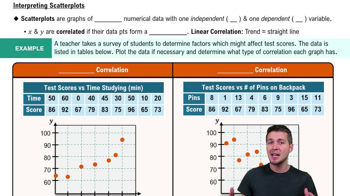
A scatterplot is a graphical representation of two variables, where each point represents an observation in the dataset. It helps visualize the relationship between the variables, allowing for the identification of patterns, trends, or correlations. In this context, plotting sound intensity against scale value will help determine how these two variables interact.
Recommended video:
Guided course
06:36
Scatterplots & Intro to Correlation

Mathematical Models

Mathematical models are equations or functions that describe the relationship between variables. In this case, the focus is on linear, quadratic, logarithmic, exponential, and power models. Each model has distinct characteristics and is suitable for different types of data patterns, making it essential to choose the one that best fits the observed data in the scatterplot.
Recommended video:
03:18
Permutations vs. Combinations

Sound Intensity and Decibel Scale

Sound intensity refers to the power per unit area carried by sound waves, often measured in watts per square meter. The decibel scale is a logarithmic scale used to quantify sound intensity levels, where each increase of 10 dB represents a tenfold increase in intensity. Understanding this relationship is crucial for interpreting the data in the context of sound measurement and its representation in the scatterplot.
Recommended video:
04:41
Creating Frequency Polygons
Related Practice
Textbook Question

Best-Fit Line


What is a residual?

In what sense is the regression line the straight line that “best” fits the points in a scatterplot?

Textbook Question

Interpreting a Computer Display

In Exercises 9–12, refer to the display obtained by using the paired data consisting of weights (pounds) and highway fuel consumption amounts (mi/gal) of the large cars included in Data Set 35 “Car Data” in Appendix B. Along with the paired weights and fuel consumption amounts, StatCrunch was also given the value of 4000 pounds to be used for predicting highway fuel consumption.


Testing for Correlation Use the information provided in the display to determine the value of the linear correlation coefficient. Is there sufficient evidence to support a claim of a linear correlation between weights of large cars and the highway fuel consumption amounts?

Textbook Question

Interpreting a Computer Display

In Exercises 9–12, refer to the display obtained by using the paired data consisting of weights (pounds) and highway fuel consumption amounts (mi/gal) of the large cars included in Data Set 35 “Car Data” in Appendix B. Along with the paired weights and fuel consumption amounts, StatCrunch was also given the value of 4000 pounds to be used for predicting highway fuel consumption.


[IMAGE]


Predicting Highway Fuel Consumption Using a car weight of x = 4000 (pounds), what is the single value that is the best predicted amount of highway fuel consumption?

Textbook Question

Randomization

For Exercises 33–36, repeat the indicated exercise using the resampling method of randomization.

Powerball Jackpots and Tickets Sold Exercise 14

Textbook Question

Coefficient of Determination Using the heights and weights described in Exercise 1, the linear correlation coefficient r is 0.394. Find the value of the coefficient of determination. What practical information does the coefficient of determination provide?

4
views
Textbook Question

Standard Error of Estimate A random sample of 118 different female statistics students is obtained and their weights are measured in kilograms and in pounds. Using the 118 paired weights (weight in kg, weight in lb), what is the value of se? For a female statistics student who weighs 100 lb, the predicted weight in kilograms is 45.4 kg. What is the 95% prediction interval?