Ch. 2 - Descriptive Statistics
Larson - Elementary Statistics: Picturing the World 8th Edition
Larson8th EditionElementary Statistics: Picturing the WorldISBN: 9780137493470Not the one you use?Change textbook
Chapter 2, Problem 2.3.66b

Extending Concepts


Trimmed Mean To find the 10% trimmed mean of a data set, order the data, delete the lowest 10% of the entries and the highest 10% of the entries, and find the mean of the remaining entries.


b. Compare the four measures of central tendency, including the midrange.

Verified step by step guidance
1
Order the data set in ascending order. This step ensures that the data is properly arranged for identifying the lowest and highest 10% of the entries.
Determine the number of entries to trim from both ends of the data set. Multiply the total number of data points by 10% (0.10) to find how many values to remove from the lowest and highest ends. If the result is not an integer, round to the nearest whole number.
Remove the lowest 10% and the highest 10% of the data points based on the calculation from the previous step. This leaves the middle portion of the data set.
Calculate the mean of the remaining data points. Add up all the remaining values and divide by the number of remaining data points to find the trimmed mean.
Compare the trimmed mean with the other measures of central tendency: the mean (average of all data points), the median (middle value of the ordered data set), and the midrange (average of the smallest and largest values in the data set). Discuss how the trimmed mean differs and why it might be more robust in the presence of outliers.

Verified video answer for a similar problem:

This video solution was recommended by our tutors as helpful for the problem above.
Video duration:
4m
Was this helpful?

Key Concepts

Here are the essential concepts you must grasp in order to answer the question correctly.

Trimmed Mean

The trimmed mean is a statistical measure that reduces the influence of outliers by removing a specified percentage of the lowest and highest values from a data set before calculating the mean. For example, in a 10% trimmed mean, the lowest 10% and highest 10% of data points are discarded, allowing for a more robust average that better represents the central tendency of the remaining data.
Recommended video:
Guided course
04:52
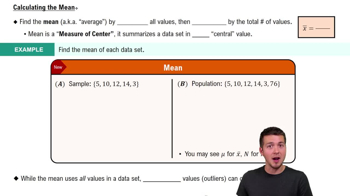
Calculating the Mean

Measures of Central Tendency

Measures of central tendency are statistical metrics that summarize a set of data by identifying the center point or typical value. The most common measures include the mean (average), median (middle value), mode (most frequent value), and midrange (average of the highest and lowest values). Each measure provides different insights, especially in the presence of skewed data or outliers.
Recommended video:
Guided course
04:52
Calculating the Mean

Midrange

The midrange is a simple measure of central tendency calculated by taking the average of the maximum and minimum values in a data set. It is defined as (max + min) / 2. While easy to compute, the midrange can be heavily influenced by outliers, making it less reliable than other measures like the mean or median in skewed distributions.
Related Practice
Textbook Question

Using and Interpreting Concepts


Using and Interpreting Concepts Finding Quartiles, Interquartile Range, and Outliers In Exercises 11 and 12,

(b) find the interquartile range


56 63 51 60 57 60 60 54 63 59 80 63 60 62 65
Textbook Question

Hourly Earnings Refer to the data set in Exercise 26 and the box-and-whisker plot you drew that represents the data set.


b. What percent of the employees made more than \$23.39 per hour?

3
views
Textbook Question

Mean Absolute Deviation Another useful measure of variation for a data set is the mean absolute deviation (MAD). It is calculated by the formula

MAD = Σ |x − x̄| / n.

b. Find the mean absolute deviation of the data set in Exercise 16. Compare your result with the sample standard deviation obtained in Exercise 16.

Textbook Question

Life Spans of Tires A brand of automobile tire has a mean life span of 35,000 miles, with a standard deviation of 2250 miles. Assume the life spans of the tires have a bell-shaped distribution.


b. The life spans of three randomly selected tires are 30,500 miles, 37,250 miles, and 35,000 miles. Using the Empirical Rule, find the percentile that corresponds to each life span.

Textbook Question

Use the ogive to approximate

the height for which the cumulative frequency is 15.

1
views
Textbook Question

What Would You Do? You work at a bank and are asked to recommend the amount of cash to put in an ATM each day. You do not want to put in too much (which would cause security concerns) or too little (which may create customer irritation). The daily withdrawals (in hundreds of dollars) for 30 days are listed. 72 84 61 76 104 76 86 92 80 88 98 76 97 82 84 67 70 81 82 89 74 73 86 81 85 78 82 80 91 83

If you put \$9000 in the ATM each day, what percent of the days in a month should you expect to run out of cash? Explain.

7
views