Ch. 4 - Probability
Triola - Elementary Statistics 14th Edition
Triola14th EditionElementary StatisticsISBN: 9780137366446Not the one you use?Change textbook
Chapter 4, Problem 4.1.23

In Exercises 21-28, find the probability and answer the questions.


Mendelian Genetics When Mendel conducted his famous genetics experiments with peas, one sample of offspring consisted of 428 green peas and 152 yellow peas. Based on those results, estimate the probability of getting an offspring pea that is green. Is the result reasonably close to the expected value of as Mendel claimed?

Verified step by step guidance
1
Step 1: Understand the problem. We are tasked with estimating the probability of getting a green pea based on the given data and comparing it to Mendel's expected value. The data provided includes 428 green peas and 152 yellow peas.
Step 2: Calculate the total number of peas. Add the number of green peas and yellow peas: Total peas = 428 + 152.
Step 3: Estimate the probability of getting a green pea. Use the formula for probability: P(green pea) = (Number of green peas) / (Total number of peas). Substitute the values from the problem into this formula.
Step 4: Compare the estimated probability to Mendel's expected value. Mendel's expected probability for green peas is typically 3/4 (based on Mendelian genetics for dominant traits). Check if the estimated probability is reasonably close to 3/4.
Step 5: Interpret the result. Discuss whether the estimated probability aligns with Mendel's claim and consider any potential reasons for discrepancies, such as sample size or experimental error.

Verified video answer for a similar problem:

This video solution was recommended by our tutors as helpful for the problem above.
Video duration:
2m
Was this helpful?

Key Concepts

Here are the essential concepts you must grasp in order to answer the question correctly.

Probability

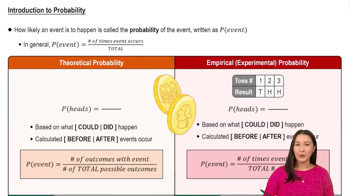
Probability is a measure of the likelihood that a particular event will occur, expressed as a number between 0 and 1. In this context, it is calculated by dividing the number of favorable outcomes (green peas) by the total number of outcomes (green and yellow peas combined). Understanding probability is essential for estimating the chances of obtaining a green pea from the given sample.
Recommended video:
5:37
Introduction to Probability

Expected Value

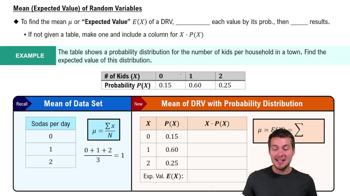
The expected value is a theoretical average of all possible outcomes of a random variable, weighted by their probabilities. In Mendelian genetics, the expected ratio of green to yellow peas can be derived from Mendel's laws of inheritance. Comparing the calculated probability of green peas to the expected value helps assess the validity of Mendel's claims regarding inheritance patterns.
Recommended video:
Guided course
04:14
Expected Value (Mean) of Random Variables

Mendelian Genetics

Mendelian genetics is the study of how traits are inherited through generations, based on the principles established by Gregor Mendel. His experiments with pea plants led to the formulation of laws of segregation and independent assortment, which predict the distribution of traits. Understanding these principles is crucial for interpreting the results of Mendel's experiments and the probabilities associated with different phenotypes.
Related Practice
Textbook Question

Notation What does the symbol ! represent? The five starting players of an NBA basketball team can stand in a line 5! different ways, so what is the actual number of ways that the five players can stand in a line?
Textbook Question

Notation For a polygraph (lie detector) used when a subject is presented with a question, let L= the subject lied and let Y = the polygraph indicated that the subject told a lie. Use your own words to translate the notation P (Y|L) into a verbal statement.

Textbook Question

Exclusive Or The exclusive or means either one or the other event occurs, but not both.

If one of the high school drivers is randomly selected, find the probability of getting one who texted while driving or drove when drinking alcohol.

b. Repeat Exercise 11 “Texting or Drinking” using the exclusive or instead of the inclusive or.

Textbook Question

Penicillin “Who discovered penicillin: Marcel Bich, William Penn, Jonas Salk, Alexander Fleming, or Louis Pasteur?” If you make a random guess for the answer to that question, what is the probability that your answer is the correct answer of Alexander Fleming?

Textbook Question

In Exercises 13–20, express the indicated degree of likelihood as a probability value between 0 and 1.


SAT Test When making a random guess for an answer to a multiple choice question on an SAT test, the possible answers are a, b, c, d, e, so there is 1 chance in 5 of being correct.

Textbook Question

In Exercises 21-28, find the probability and answer the questions.


YSORT Gender Selection MicroSort’s YSORT gender selection technique is designed to increase the likelihood that a baby will be a boy. At one point before clinical trials of the YSORT gender selection technique were discontinued, 291 births consisted of 239 baby boys and 52 baby girls (based on data from the Genetics & IVF Institute). Based on these results, what is the probability of a boy born to a couple using MicroSort’s YSORT method? Does it appear that the technique is effective in increasing the likelihood that a baby will be a boy?