
Ch. 8 - Hypothesis Testing
Triola - Elementary Statistics 14th Edition
Triola14th EditionElementary StatisticsISBN: 9780137366446Not the one you use?Change textbook
Chapter 8, Problem 8.1.23

Final Conclusions
In Exercises 21–24, use a significance level of α = 0.05 and use the given information for the following:


State a conclusion about the null hypothesis. (Reject H0 or fail to reject H0.)
Without using technical terms or symbols, state a final conclusion that addresses the original claim.


Original claim: The mean pulse rate (in beats per minute) of adult males is 72 bpm. The hypothesis test results in a P-value of 0.0095.

Verified step by step guidance
1
Step 1: Identify the null hypothesis (H0) and the alternative hypothesis (H1). The null hypothesis (H0) is that the mean pulse rate of adult males is 72 bpm. The alternative hypothesis (H1) is that the mean pulse rate of adult males is not 72 bpm.
Step 2: Compare the given P-value (0.0095) to the significance level (α = 0.05). Recall that if the P-value is less than α, we reject the null hypothesis. Otherwise, we fail to reject the null hypothesis.
Step 3: Since the P-value (0.0095) is less than the significance level (0.05), the decision is to reject the null hypothesis (H0).
Step 4: Translate the statistical decision into a non-technical conclusion. Since we rejected the null hypothesis, this suggests that there is sufficient evidence to conclude that the mean pulse rate of adult males is not 72 bpm.
Step 5: Summarize the findings. Based on the hypothesis test, we have enough evidence to refute the original claim that the mean pulse rate of adult males is 72 bpm.

Verified video answer for a similar problem:

This video solution was recommended by our tutors as helpful for the problem above.
Video duration:
2m
Was this helpful?

Key Concepts

Here are the essential concepts you must grasp in order to answer the question correctly.

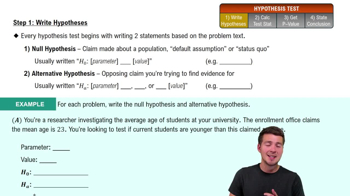
Null Hypothesis (H0)

The null hypothesis is a statement that there is no effect or no difference, serving as a default position in hypothesis testing. In this context, it posits that the mean pulse rate of adult males is 72 beats per minute. The goal of hypothesis testing is to determine whether there is enough evidence to reject this assumption based on sample data.
Recommended video:
Guided course
06:21
Step 1: Write Hypotheses

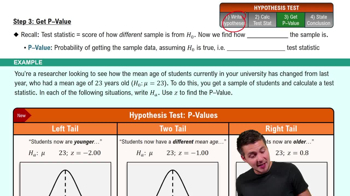
P-value

The P-value is a statistical measure that helps determine the significance of the results from a hypothesis test. It represents the probability of obtaining results at least as extreme as the observed results, assuming the null hypothesis is true. A low P-value, such as 0.0095 in this case, indicates strong evidence against the null hypothesis, suggesting that it may be rejected.
Recommended video:
Guided course
06:50
Step 3: Get P-Value

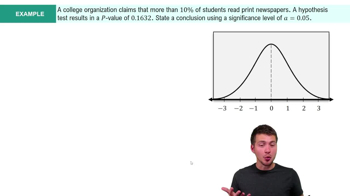
Significance Level (α)

The significance level, denoted as α, is a threshold set by the researcher to determine when to reject the null hypothesis. In this scenario, α is set at 0.05, meaning that if the P-value is less than 0.05, the null hypothesis can be rejected. This level reflects the acceptable risk of making a Type I error, which is rejecting a true null hypothesis.
Recommended video:
Guided course
04:46
Step 4: State Conclusion Example 4
Related Practice
Textbook Question

Testing Claims About Variation

In Exercises 5–16, test the given claim. Identify the null hypothesis, alternative hypothesis, test statistic, P-value, or critical value(s), then state the conclusion about the null hypothesis, as well as the final conclusion that addresses the original claim. Assume that a simple random sample is selected from a normally distributed population.


Minting of Pennies Data Set 40 “Coin Weights” lists weights (grams) of pennies minted after 1983. Here are the statistics for those weights: n = 37, xbar = 2.49910 g, s = 0.01648 g . Use a 0.05 significance level to test the claim that the sample is from a population of pennies with weights having a standard deviation greater than 0.01000 g.

Textbook Question

Test Statistic and Critical Value The statistics for the sample data in Exercise 1 are n = 15, x_bar = 6.133333, and s = 8.862978, where the units are millions of dollars. Find the test statistic and critical value(s) for a test of the claim that the salaries are from a population with a mean greater than 5 million dollars. Assume that a 0.05 significance level is used.

1
views
Textbook Question

Estimates vs. Hypothesis Tests Labels on cans of Dr. Pepper soda indicate that they contain 12 oz of the drink. We could collect samples of those cans and accurately measure the actual contents, then we could use methods of Section 7-2 for making an estimate of the mean amount of Dr. Pepper in cans, or we could use those measured amounts to test the claim that the cans contain a mean of 12 oz. What is the difference between estimating the mean and testing a hypothesis about the mean?

Textbook Question

Lightning Deaths Listed below are the numbers of deaths from lightning strikes in the United States each year for a sequence of recent and consecutive years. Find the values of the indicated statistics.

46 51 44 51 43 32 38 48 45 27 34 29 26 28 23 26 28 40 16 20

f. What important feature of the data is not revealed from an examination of the statistics, and what tool would be helpful in revealing it? What does a quick examination of the data reveal?

3
views
Textbook Question

Discarded Plastic The P-value for the hypothesis test described in Exercise 1 is 0.2565.


What should be concluded about the null hypothesis?

What is the final conclusion that addresses the original claim?

Textbook Question

Randomization: Testing a Claim About a Mean

In Exercises 9–12, use the randomization procedure for the indicated exercise.

Section 8-3, Exercise 23 “Cell Phone Radiation”