Ch. 8 - Hypothesis Testing with Two Samples
Larson - Elementary Statistics: Picturing the World 8th Edition
Larson8th EditionElementary Statistics: Picturing the WorldISBN: 9780137493470Not the one you use?Change textbook
Chapter 8, Problem 8.4.14

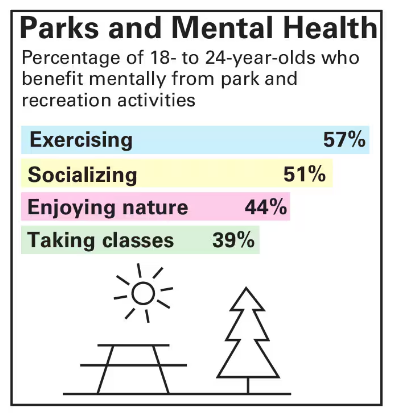
Parks and Mental Health In Exercises 13–18, use the figure, which shows the percentages from a survey of two hundred 18- to 24-year-olds in the United States who say that various park and recreation activities have a positive impact on their mental health. (Adapted from National Recreation and Park Association)


Taking Classes and Enjoying Nature At α=0.05, can you support the claim that the proportion of 18- to 24-year-olds who benefit mentally from taking classes in parks is less than the proportion who benefit mentally from enjoying nature in parks?

Verified step by step guidance
1
Step 1: Define the null hypothesis (H₀) and the alternative hypothesis (H₁). H₀: The proportion of 18- to 24-year-olds who benefit mentally from taking classes in parks is equal to or greater than the proportion who benefit mentally from enjoying nature in parks. H₁: The proportion of 18- to 24-year-olds who benefit mentally from taking classes in parks is less than the proportion who benefit mentally from enjoying nature in parks.
Step 2: Identify the sample proportions from the data provided in the image. The proportion for enjoying nature is 44% (p₁ = 0.44), and the proportion for taking classes is 39% (p₂ = 0.39). Also, note the sample size (n₁ = n₂ = 200).
Step 3: Calculate the test statistic for comparing two proportions. Use the formula: z = (p₁ - p₂) / sqrt(p̂(1 - p̂)(1/n₁ + 1/n₂)), where p̂ = (x₁ + x₂) / (n₁ + n₂). Here, x₁ and x₂ are the number of successes for each group, and n₁ and n₂ are the sample sizes.
Step 4: Determine the critical value for α = 0.05 in a one-tailed test. Look up the z-value corresponding to a significance level of 0.05 in a z-table. This will be the threshold for rejecting the null hypothesis.
Step 5: Compare the calculated test statistic to the critical value. If the test statistic is less than the critical value, reject the null hypothesis and conclude that the proportion of 18- to 24-year-olds who benefit mentally from taking classes in parks is less than the proportion who benefit mentally from enjoying nature in parks. Otherwise, fail to reject the null hypothesis.

Verified video answer for a similar problem:

This video solution was recommended by our tutors as helpful for the problem above.
Video duration:
5m
Was this helpful?

Key Concepts

Here are the essential concepts you must grasp in order to answer the question correctly.

Hypothesis Testing

Hypothesis testing is a statistical method used to make decisions about a population based on sample data. It involves formulating a null hypothesis (H0) and an alternative hypothesis (H1). In this context, the null hypothesis would state that the proportion of 18- to 24-year-olds benefiting from taking classes is equal to or greater than those benefiting from enjoying nature, while the alternative hypothesis would claim the opposite.
Recommended video:
Guided course
06:21
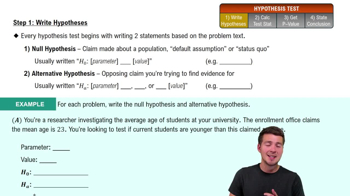
Step 1: Write Hypotheses

Proportions

Proportions are a way to express a part of a whole, often represented as a fraction or percentage. In this question, we are comparing the proportions of two groups: those who benefit from taking classes (39%) and those who benefit from enjoying nature (44%). Understanding how to calculate and interpret these proportions is crucial for analyzing the survey data and drawing conclusions.
Recommended video:
Guided course
09:27
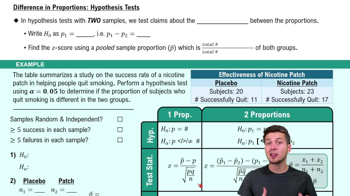
Difference in Proportions: Hypothesis Tests

Significance Level (α)

The significance level, denoted as α, is the threshold for determining whether to reject the null hypothesis in hypothesis testing. A common significance level is 0.05, which indicates a 5% risk of concluding that a difference exists when there is none. In this scenario, using α=0.05 means that if the p-value from the test is less than 0.05, we can conclude that there is significant evidence to support the claim that fewer young adults benefit from taking classes compared to enjoying nature.
Recommended video:
03:33
Finding Binomial Probabilities Using TI-84 Example 1
Related Practice
Textbook Question

Yellowfin Tuna

A marine biologist claims that the mean fork length (see figure at the left) of yellowfin tuna is different in two zones in the eastern tropical Pacific Ocean. A sample of 26 yellowfin tuna collected in Zone A has a mean fork length of 76.2 centimeters and a standard deviation of 16.5 centimeters. A sample of 31 yellowfin tuna collected in Zone B has a mean fork length of 80.8 centimeters and a standard deviation of 23.4 centimeters. At ,α=0.01 can you support the marine biologist’s claim? Assume the population variances are equal. (Adapted from Fishery Bulletin)

1
views
Textbook Question

Daily Activities In Exercises 19–22, the results of a survey of 200 U.S. randomly selected U.S. men and 300 randomly selected U.S. women are shown in the figure at the left, which displays the percentages engaged in working or socializing and communicating on an average day. (Adapted from U.S. Bureau of Labor Statistics)


Women’s Activities At α=0.01, can you reject the claim that the proportion of women who work is the same as the proportion of women who socialize and communicate on an average day?

Textbook Question

Testing the Difference Between Two Means In Exercises 15–24, (a) identify the claim and state Ho and Ha, (b) find the critical value(s) and identify the rejection region(s), (c) find the standardized test statistic z, (d) decide whether to reject or fail to reject the null hypothesis, and (e) interpret the decision in the context of the original claim. Assume the samples are random and independent, and the populations are normally distributed.

Home Prices A real estate agency says that the mean home sales price in Casper, Wyoming, is the same as in Cheyenne, Wyoming. The mean home sales price for 35 homes in Casper is \$349,237. Assume the population standard deviation is \$158,005. The mean home sales price for 41 homes in Cheyenne is \$435,244. Assume the population standard deviation is \$154,716. At α=0.01, is there enough evidence to reject the agency’s claim? (Adapted from Realtor.com)

Textbook Question

Testing the Difference Between Two Means In Exercises 15–24, (a) identify the claim and state Ho and Ha, (b) find the critical value(s) and identify the rejection region(s), (c) find the standardized test statistic z, (d) decide whether to reject or fail to reject the null hypothesis, and (e) interpret the decision in the context of the original claim. Assume the samples are random and independent, and the populations are normally distributed.

Repair Costs: Washing Machines You want to buy a washing machine, and a salesperson tells you that the mean repair costs for Model A and Model B are equal. You research the repair costs. The mean repair cost of 24 Model A washing machines is \$208. Assume the population standard deviation is \$18. The mean repair cost of 26 Model B washing machines is \$221. Assume the population standard deviation is \$22. At α=0.01, can you reject the salesperson’s claim?

Textbook Question

Test the claim about the mean of the differences for a population of paired data at the level of significance α. Assume the samples are random and dependent, and the populations are normally distributed.

Claim: μd≠0 , α=0.10, Sample statistics: d̄ =-1, sd=2.75, n=20