Ch. 5 - Normal Probability Distributions
Larson - Elementary Statistics: Picturing the World 8th Edition
Larson8th EditionElementary Statistics: Picturing the WorldISBN: 9780137493470Not the one you use?Change textbook
Chapter 5, Problem 5.4.28

Repeat Exercise 26 for samples of size 72 and 108. What happens to the mean and the standard deviation of the distribution of sample means as the sample size increases?

Verified step by step guidance
1
Understand the problem: The question is asking about the behavior of the mean and standard deviation of the sampling distribution of sample means as the sample size increases. This involves concepts from the Central Limit Theorem (CLT).
Recall the properties of the sampling distribution of the sample mean: (1) The mean of the sampling distribution (μₓ̄) is equal to the population mean (μ). (2) The standard deviation of the sampling distribution (σₓ̄) is equal to the population standard deviation (σ) divided by the square root of the sample size (n). This is expressed as: σx̄=σn.
For sample size 72: Substitute n = 72 into the formula for the standard deviation of the sampling distribution. The formula becomes: σx̄=σ72. The mean remains the same as the population mean (μ).
For sample size 108: Substitute n = 108 into the formula for the standard deviation of the sampling distribution. The formula becomes: σx̄=σ108. Again, the mean remains the same as the population mean (μ).
Interpret the results: As the sample size (n) increases, the denominator of the formula for the standard deviation of the sampling distribution increases (since it involves the square root of n). This causes the standard deviation of the sampling distribution (σₓ̄) to decrease. However, the mean of the sampling distribution (μₓ̄) remains unchanged and equal to the population mean (μ).

Verified video answer for a similar problem:

This video solution was recommended by our tutors as helpful for the problem above.
Video duration:
6m
Was this helpful?

Key Concepts

Here are the essential concepts you must grasp in order to answer the question correctly.

Central Limit Theorem

The Central Limit Theorem states that, regardless of the population distribution, the distribution of sample means will approach a normal distribution as the sample size increases, typically becoming approximately normal when the sample size is 30 or more. This theorem is fundamental in statistics as it allows for the use of normal probability techniques for inference about population parameters.
Recommended video:
Guided course
04:52
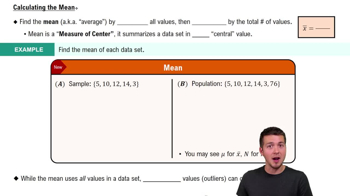
Calculating the Mean

Standard Error of the Mean

The Standard Error of the Mean (SEM) quantifies the variability of sample means around the population mean. It is calculated as the population standard deviation divided by the square root of the sample size. As the sample size increases, the SEM decreases, indicating that larger samples provide more precise estimates of the population mean.
Recommended video:
Guided course
04:52
Calculating the Mean

Effect of Sample Size on Distribution

As the sample size increases, the mean of the distribution of sample means remains constant and equal to the population mean, while the standard deviation of the sample means (the standard error) decreases. This means that larger samples yield more reliable estimates, leading to a tighter clustering of sample means around the population mean.
Recommended video:
05:11
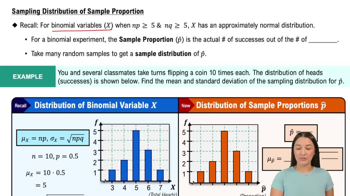
Sampling Distribution of Sample Proportion