Ch. 5 - Normal Probability Distributions
Larson - Elementary Statistics: Picturing the World 8th Edition
Larson8th EditionElementary Statistics: Picturing the WorldISBN: 9780137493470Not the one you use?Change textbook
Chapter 5, Problem 5.5.32

Testing a Drug A drug manufacturer claims that a drug cures a rare skin disease 75% of the time. The claim is checked by testing the drug on 100 patients. If at least 70 patients are cured, then this claim will be accepted. Use this information in Exercises 31 and 32.


Find the probability that the claim will be accepted, assuming that the actual probability that the drug cures the skin disease is 65%.

Verified step by step guidance
1
Step 1: Identify the type of probability distribution. Since the problem involves a fixed number of trials (100 patients), each with two possible outcomes (cured or not cured), and a constant probability of success (65%), this is a binomial distribution. The binomial distribution is defined as P(X = k) = (n choose k) * p^k * (1-p)^(n-k), where n is the number of trials, k is the number of successes, and p is the probability of success.
Step 2: Define the random variable and parameters. Let X represent the number of patients cured. Here, n = 100 (number of trials), p = 0.65 (probability of success), and we are interested in the probability that at least 70 patients are cured, i.e., P(X ≥ 70).
Step 3: Rewrite the probability using the complement rule. Since calculating P(X ≥ 70) directly can be cumbersome, use the complement rule: P(X ≥ 70) = 1 - P(X < 70). This simplifies to P(X ≥ 70) = 1 - P(X ≤ 69).
Step 4: Use the cumulative distribution function (CDF) of the binomial distribution. The CDF gives the probability of X being less than or equal to a certain value. Calculate P(X ≤ 69) using the binomial CDF formula or a statistical software/calculator. The formula for the CDF is the sum of binomial probabilities: P(X ≤ 69) = Σ (from k=0 to 69) [(n choose k) * p^k * (1-p)^(n-k)].
Step 5: Subtract the CDF value from 1 to find the final probability. Once you have P(X ≤ 69), subtract it from 1 to get P(X ≥ 70). This result represents the probability that the claim will be accepted, assuming the actual probability of curing the disease is 65%.

Verified video answer for a similar problem:

This video solution was recommended by our tutors as helpful for the problem above.
Video duration:
7m
Was this helpful?

Key Concepts

Here are the essential concepts you must grasp in order to answer the question correctly.

Binomial Distribution

The binomial distribution models the number of successes in a fixed number of independent Bernoulli trials, each with the same probability of success. In this scenario, curing patients can be seen as a success, and the distribution helps calculate the probability of curing a certain number of patients out of 100, given a specific success rate.
Recommended video:
Guided course
03:28
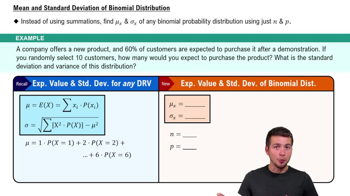
Mean & Standard Deviation of Binomial Distribution

Hypothesis Testing

Hypothesis testing is a statistical method used to make decisions about a population based on sample data. In this case, the null hypothesis would be that the drug cures 65% of patients, while the alternative hypothesis is that it cures at least 70 patients. The test evaluates whether the observed data provides sufficient evidence to reject the null hypothesis.
Recommended video:
Guided course
06:21
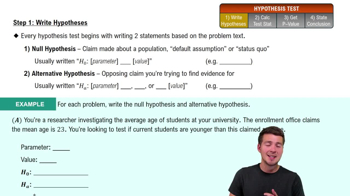
Step 1: Write Hypotheses

Cumulative Probability

Cumulative probability refers to the probability that a random variable takes on a value less than or equal to a specific value. In this context, it involves calculating the probability of curing at least 70 patients out of 100, which requires summing the probabilities of curing 70, 71, ..., up to 100 patients using the binomial distribution with a success rate of 65%.
Recommended video:
5:37
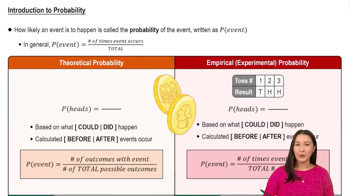
Introduction to Probability
Related Practice
Textbook Question

In Exercises 39 and 40, determine whether the finite correction factor should be used. If so, use it in your calculations when you find the probability.


Parking Infractions In a sample of 1000 fines issued by the City of Toronto for parking infractions in September of 2020, the mean fine was \$49.83 and the standard deviation was \$52.15. A random sample of size 60 is selected from this population. What is the probability that the mean fine is less than \$40?

Textbook Question

Draw two normal curves that have the same mean but different standard deviations. Describe the similarities and differences.

Textbook Question

Graphical Analysis In Exercises 11–16, determine whether the graph could represent a variable with a normal distribution. Explain your reasoning. If the graph appears to represent a normal distribution, estimate the mean and standard deviation.

Textbook Question

In Exercises 21–24, a control chart is shown. Each chart has horizontal lines drawn at the mean mu, at mu ±2sigma, and at mu±3sigma. Determine whether the process shown is in control or out of control. Explain.


A gear has been designed to have a diameter of 3 inches. The standard deviation of the process is 0.2 inch.


Textbook Question

Finding Probabilities for Sampling Distributions In Exercises 29–32, find the indicated probability and interpret the results.


Dow Jones Industrial Average From 1975 through 2020, the mean annual gain of the Dow Jones Industrial Average was 652. A random sample of 32 years is selected from this population. What is the probability that the mean gain for the sample was between 400 and 700? Assume sigma=1540

Textbook Question

"Getting Physical The figure shows the results of a survey of U.S. adults ages 18 to 29 who were asked whether they participated in a sport. In the survey, 48% of the men and 23% of the women said they participate in sports. The most common sports are shown below. Use this information in Exercises 29 and 30.


You randomly select 300 U.S. women ages 18 to 29 and ask them whether they participate in at least one sport. Of the 72 who say yes, 50% say they participate in volleyball. How likely is this result? Do you think this sample is a good one? Explain your reasoning."