 Back
BackSociology: Culture_updated public
 00:56
00:56
Terms in this set (32)
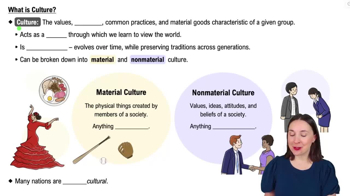
Culture is the values, beliefs, common practices, and material goods characteristic of a given group. It acts as a lens through which we learn to view the world and is dynamic, evolving over time while preserving traditions.
Material culture includes physical objects created by society. Nonmaterial culture includes values, ideas, attitudes, and beliefs.
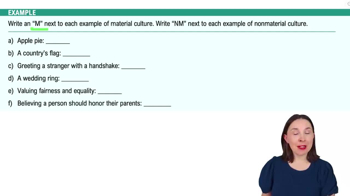
Material: apple pie, country’s flag, wedding ring. Nonmaterial: greeting with handshake, valuing fairness, honoring parents.
Ethnocentrism is evaluating and judging another culture based on one’s own cultural norms, often believing one’s culture is superior or the default.
Cultural relativism is assessing a culture based on its own standards without judgment, requiring openness to new values and customs.
Culture shock is a sense of disorientation when entering a new cultural environment, experienced regardless of mindset.
High culture is associated with society’s elite and requires cultural capital. Pop culture is widespread and accessible to most people.
A subculture is a smaller cultural group with distinct values and norms within a larger culture that operates smoothly alongside mainstream society.
A counterculture is a subculture that actively opposes the dominant culture’s norms and values.
Ideal culture reflects the standards a society would like to embrace. Real culture is what actually happens in everyday life and may align or contradict ideal culture.
Values are broad ideas about what is good, desirable, and important, often shared at the societal level and influencing laws and policies.
Beliefs are specific ideas or convictions people hold to be true, explaining why values matter and how they apply to daily life.
Norms are shared rules and expectations that guide behavior and maintain social order.
Mores are norms with strong moral significance; violations are shameful or punishable. Folkways are norms for routine interactions with weaker moral underpinnings; violations are seen as odd.
Symbols are anything that carries a particular meaning recognized by people who share a culture.
Language is a system of symbols that allows people to communicate and transmit culture across generations.
The Sapir-Whorf hypothesis suggests that people see and understand the world through the cultural lens of their language, which can influence perception and thought.
Symbols can have different meanings across cultures, as shown by examples like road signs that differ in meaning between societies.
Gabriel is practicing cultural relativism, approaching new cultures with openness and without judgment.
A value is a shared idea about what is good or desirable in a society, guiding behavior and social norms.
What is culture?
A value is a shared idea about what is good or desirable in a society, guiding behavior and social norms.
What is culture?22
A value is a shared idea about what is good or desirable in a society, guiding behavior and social norms.
What is culture23
A value is a shared idea about what is good or desirable in a society, guiding behavior and social norms.
A value is a shared idea about what is good or desirable in a society, guiding behavior and social norms 24
A value is a shared idea about what is good or desirable in a society, guiding behavior and social norms.
A value is a shared idea about what is good or desirable in a society, guiding behavior and social norms 25
A value is a shared idea about what is good or desirable in a society, guiding behavior and social norms.
A value is a shared idea about what is good or desirable in a society, guiding behavior and social norms27
A value is a shared idea about what is good or desirable in a society, guiding behavior and social norms.
what is culture 28
A value is a shared idea about what is good or desirable in a society, guiding behavior and social norms.
what is culture 29
A value is a shared idea about what is good or desirable in a society, guiding behavior and social norms.
culture 30
A value is a shared idea about what is good or desirable in a society, guiding behavior and social norms.
culture 31
A value is a shared idea about what is good or desirable in a society, guiding behavior and social norms.
culture 32
A value is a shared idea about what is good or desirable in a society, guiding behavior and social norms.
culture 33
A value is a shared idea about what is good or desirable in a society, guiding behavior and social norms.
A value is a shared idea about what is good or desirable in a society, guiding behavior and social norms.