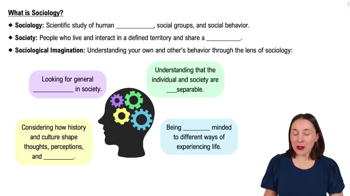
Sociology is the scientific study of human society, social groups, and social behavior.
What does a society consist of in sociology?
A society consists of people who live in and interact within a defined territory and share a culture.
What is the sociological imagination?
The sociological imagination is understanding your own and others' behavior through the lens of sociology, considering obtained patterns, history, and culture.
Why is it important to look for general patterns in societies?
Looking for general patterns helps sociologists understand behavioral and historical trends within a society.
How do history and culture influence individuals according to sociology?
History and culture shape people's thoughts, perceptions, and potential biases.
Why are individuals and society considered inseparable in sociology?
Individuals cannot be fully separated from the context of their society and environment.
What mindset does sociology encourage students to adopt?
Sociology encourages students to be open-minded toward different ways of experiencing life.
What are some topics covered in sociology?
Sociology covers topics like types of societies, systems of government, crime and punishment, religion, and family formation.
How does sociology help analyze social phenomena?
Sociology helps analyze social patterns, norms, and institutions to understand complex social phenomena.
What is the role of socialization in sociology?
Socialization is a key concept in sociology, focusing on how individuals learn and adopt the norms and values of their society.
How does sociology view the relationship between individuals and their environment?
Sociology sees individuals as deeply influenced by and connected to their social environment.
What does it mean to practice open-mindedness in sociology?
Practicing open-mindedness means being receptive to diverse life experiences and perspectives.
Why is it important to consider historical context in sociology?
Historical context helps explain why societies and individuals behave in certain ways.
What are social structures in sociology?
Social structures are organized patterns of relationships and institutions that shape society.
How does sociology approach the study of crime and punishment?
Sociology examines how different societies think about and handle crime and punishment as part of social behavior.
 Back
Back
 00:35
00:35