Skip to main content
Sociology
My Course
Learn
AI Tutor
Study Guides
Flashcards
Explore
Try the app
My Course
Learn
AI Tutor
Study Guides
Flashcards
Explore
Try the app
Back
What is Social Stratification? quiz
You can tap to flip the card.
What is social stratification?
You can tap to flip the card.
👆
What is social stratification?
Social stratification is the way a society ranks individuals into hierarchical categories or social classes.
Track progress
Control buttons has been changed to "navigation" mode.
1/15
Related flashcards
Recommended videos
What is Social Stratification? definitions
What is Social Stratification?
15 Terms
Guided course
03:30
What is Social Stratification?
1
views
Guided course
01:00
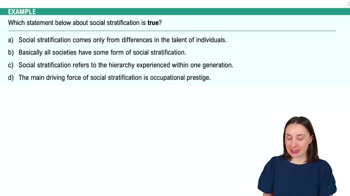
What is Social Stratification Example 1
Terms in this set (15)
Hide definitions
What is social stratification?
Social stratification is the way a society ranks individuals into hierarchical categories or social classes.
Is social stratification found in all societies?
Yes, social stratification is a universal concept found in basically all societies.
How does social stratification vary between societies?
Different societies use different categories and metrics to create social classes, making stratification variable.
Is stratification a trait of individuals or society?
Stratification is a trait of society, not of individual differences.
How is social class typically passed down?
Social class is often inherited from one's parents and can be perpetuated across generations.
What is social mobility?
Social mobility is the ability for individuals to change their social class within a society.
What two main aspects does stratification involve?
Stratification involves both material inequalities (like wealth and power) and cultural beliefs that justify these differences.
What are some key factors that influence social stratification?
Key factors include wealth, income, education, power, and occupational prestige.
How are wealth and income related to stratification?
Wealth and income are major factors that determine a person's position within the social hierarchy.
What is the difference between wealth and income?
Income is money actively coming into a person, while wealth is a person's net worth, including assets and income.
Give examples of assets that contribute to wealth.
Examples include a home, car, stocks, and bonds.
How do cultural beliefs affect social stratification?
Cultural beliefs can justify and perpetuate the existing system of stratification within a society.
What is occupational prestige?
Occupational prestige refers to how well respected a person's job is within their society and the perks or power it may provide.
Are wealth, income, education, power, and occupational prestige usually correlated?
Yes, in many societies these factors are highly correlated, though variations can exist.
Why is it important to distinguish between wealth and income in studying stratification?
Distinguishing between wealth and income helps clarify how social structures perpetuate inequality and influence social roles.
 BackBack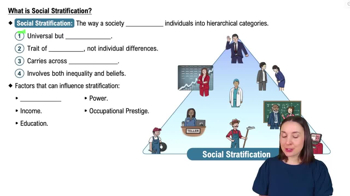
 03:30
03:30