Skip to main content
Sociology
My Course
Learn
AI Tutor
Study Guides
Flashcards
Explore
Try the app
My Course
Learn
AI Tutor
Study Guides
Flashcards
Explore
Try the app
Back
Types of Societies definitions
You can tap to flip the card.
Technological Advancement
You can tap to flip the card.
👆
Technological Advancement
Progress in tools, energy sources, and techniques that drive changes in social structure and organization over time.
Track progress
Control buttons has been changed to "navigation" mode.
1/15
Related flashcards
Recommended videos
Types of Societies quiz
Types of Societies
15 Terms
Guided course
02:17
Review of Societies
1
views
Guided course
00:48
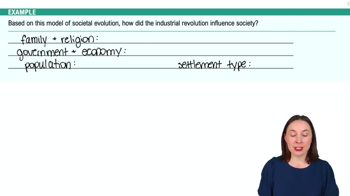
Types of Societies Example 2
1
views
Guided course
01:22
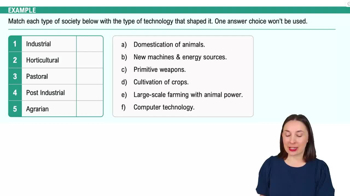
Types of Societies Example 1
1
views
Terms in this set (15)
Hide definitions
Technological Advancement
Progress in tools, energy sources, and techniques that drive changes in social structure and organization over time.
Hunter-Gatherer Society
Small, nomadic communities relying on basic weapons for subsistence, with family and spirituality as main organizing forces.
Pastoral Society
Groups centered on animal domestication, often nomadic, with family and emerging religious leadership guiding organization.
Horticultural Society
Communities practicing crop cultivation with hand tools, leading to small permanent villages and increased religious influence.
Agrarian Society
Societies using animal power for large-scale farming, resulting in population growth, permanent settlements, and rising government roles.
Industrial Society
Large urban populations shaped by machines, coal, steam, and electricity, with economy and government as primary institutions.
Postindustrial Society
Vast urban communities driven by computers and information technology, where economy and government dominate social organization.
Agricultural Revolution
Historical shift introducing farming and animal domestication, enabling population growth and new social structures.
Industrial Revolution
Era marked by new machines, power sources, and building materials, transforming settlements and occupational roles.
Material Surplus
Production of resources exceeding basic survival needs, allowing for new occupations and social stratification.
Occupational Specialization
Development of diverse roles beyond subsistence tasks, such as artisans or soldiers, enabled by resource abundance.
Social Stratification
Hierarchical arrangement of individuals based on occupation, wealth, or power, emerging with surplus and specialization.
Division of Labor
Allocation of specific tasks to different individuals or groups, increasing efficiency and complexity in society.
Settlement Type
Pattern of community living, ranging from nomadic bands to permanent villages and cities, shaped by technology.
Organizational Structure
Framework of key institutions—such as family, religion, economy, and government—that maintain and guide society.
 BackBack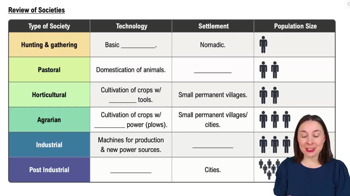
 02:17
02:17