Skip to main content
Sociology
My Course
Learn
AI Tutor
Study Guides
Flashcards
Explore
Try the app
My Course
Learn
AI Tutor
Study Guides
Flashcards
Explore
Try the app
Back
Theoretical Perspectives on Society definitions
You can tap to flip the card.
Functionalism
You can tap to flip the card.
👆
Functionalism
A perspective viewing society as a system of interrelated structures, each contributing to overall stability and order.
Track progress
Control buttons has been changed to "navigation" mode.
1/15
Related flashcards
Recommended videos
Theoretical Perspectives on Society quiz
Theoretical Perspectives on Society
15 Terms
Guided course
03:44
Conflict Perspective: Karl Marx Part 1
1
views
Guided course
01:14
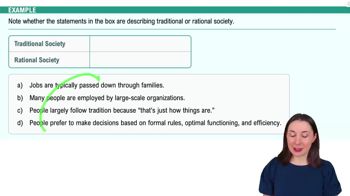
Theoretical Perspectives on Society Example 5
1
views
Guided course
06:05
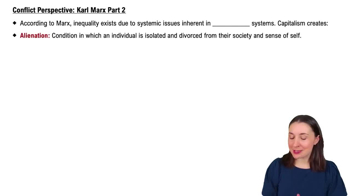
Conflict Perspective: Karl Marx Part 2
1
views
Terms in this set (15)
Hide definitions
Functionalism
A perspective viewing society as a system of interrelated structures, each contributing to overall stability and order.
Mechanical Solidarity
A form of social cohesion in preindustrial societies based on shared values, traditions, and moral consensus.
Organic Solidarity
A type of social cohesion in industrial societies where bonds arise from interdependence and occupational specialization.
Social Integration
The strength of individual social ties, considered vital for personal well-being and societal stability.
Anomie
A state of normlessness and moral confusion occurring during rapid social change or upheaval.
Materialism
A viewpoint emphasizing material conditions, such as the economy and labor, as the foundation of society.
Infrastructure
The economic base of society, seen as the foundation upon which all other institutions depend.
Superstructure
The collection of social institutions, like government and education, shaped by and supporting the economic base.
Class Conflict
The struggle between social groups over wealth and power, especially between capitalists and proletarians.
Alienation
A condition where individuals feel isolated from work, products, others, and their own sense of self.
False Consciousness
A mindset preventing recognition of social inequality, often upholding the interests of dominant groups.
Class Consciousness
An awareness of one's social class and shared interests, often leading to collective action for change.
Idealism
A perspective highlighting human ideas, values, and beliefs as the primary forces shaping society.
Rationalization
The process where societies increasingly prioritize logic, efficiency, and technical competence over tradition.
Protestant Ethic
A value system linking hard work and wealth accumulation to religious virtue, influencing the rise of capitalism.
 BackBack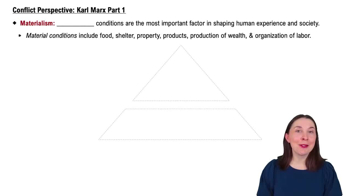
 03:44
03:44