Skip to main content
Sociology
My Course
Learn
AI Tutor
Study Guides
Flashcards
Explore
Try the app
My Course
Learn
AI Tutor
Study Guides
Flashcards
Explore
Try the app
Back
Theoretical Perspectives on Government and Politics definitions
You can tap to flip the card.
Functionalist Perspective
You can tap to flip the card.
👆
Functionalist Perspective
A view that sees government as essential for societal stability, focusing on planning, law enforcement, public needs, and international relations.
Track progress
Control buttons has been changed to "navigation" mode.
1/15
Related flashcards
Recommended videos
Theoretical Perspectives on Government and Politics quiz
Theoretical Perspectives on Government and Politics
15 Terms
Guided course
01:15
Theoretical Perspectives on Government and Politics Example 2
Guided course
01:01
Theoretical Perspectives on Government and Politics Example 3
2
views
Guided course
02:31
Conflict Perspective on Government: Power Elite Model
1
views
Terms in this set (15)
Hide definitions
Functionalist Perspective
A view that sees government as essential for societal stability, focusing on planning, law enforcement, public needs, and international relations.
Social Institution
A structured system, such as government, that organizes and regulates key aspects of society to maintain order and meet collective needs.
Pluralist Model
An approach where power is distributed among diverse groups, ensuring negotiation, compromise, and representation of various interests.
Democracy
A political system where power is shared among groups, allowing for negotiation and preventing dominance by any single group.
Conflict Perspective
A framework emphasizing how power structures and government perpetuate inequality, often benefiting the wealthy over workers.
Political Economy Model
A theory linking economic systems with political structures, asserting that economic forces shape government and laws.
Capitalist Class
A group comprising business owners and the wealthy, seen as holding significant influence over politics and resources.
Workers
Individuals who are often exploited and excluded from political influence due to limited resources in capitalist societies.
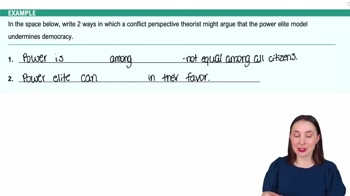
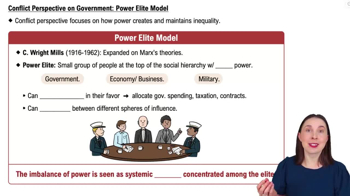
Power Elite Model
A theory highlighting a small group at the top of the social hierarchy who control major decisions and resources.
Power Elite
A select group of ultra-wealthy individuals, top officials, and military leaders who dominate key spheres of influence.
Social Hierarchy
A ranking system within society where certain groups or individuals hold more power, status, or resources than others.
Spheres of Influence
Distinct domains such as government, military, and business where powerful individuals can exert control and move between roles.
Inequality
A systemic condition where resources, power, and opportunities are unevenly distributed, often perpetuated by political and economic systems.
Political Authority
The legitimate power held by individuals or groups to make decisions and enforce rules within a society.
Social Stratification
The arrangement of individuals or groups into hierarchical layers based on power, wealth, or status.
 BackBack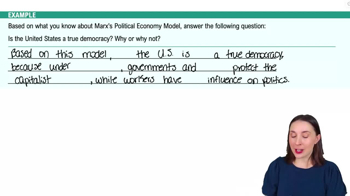
 01:15
01:15