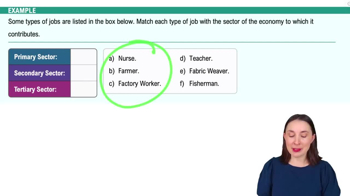
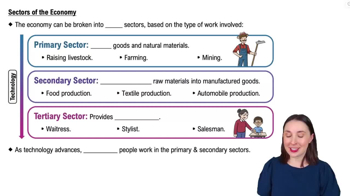
The three main sectors are the primary, secondary, and tertiary sectors.
What type of work is found in the primary sector?
The primary sector involves the extraction or production of raw goods and natural materials, such as farming, mining, fishing, and raising livestock.
What is the main activity of the secondary sector?
The secondary sector transforms raw materials into manufactured goods, often through factory-based jobs like food or textile production.
What kinds of jobs are typical in the tertiary sector?
The tertiary sector provides professional, administrative, or consumer services, including jobs like waitressing, sales, and styling.
How does technological advancement affect employment in the economic sectors?
As technology advances, fewer people work in the primary and secondary sectors, with more employment shifting to the tertiary sector.
Which sectors dominate employment in low-income countries?
Low-income countries have more employment in the primary and secondary sectors, focusing on raw goods extraction and factory work.
What sector is most prevalent in high-income countries?
High-income countries have most of their workforce in the tertiary sector, emphasizing service-based jobs.
What percentage of work in high-income countries is in the tertiary sector, according to 2024 data?
About 76% of work in high-income countries is in the tertiary sector.
How much of the workforce in low-income countries is employed in the primary and secondary sectors?
About half of the workforce in low-income countries is employed in the primary and secondary sectors.
What is the approximate percentage of primary sector employment in high-income countries?
Only about 1% of the workforce in high-income countries is employed in the primary sector.
How do middle-income countries compare in their employment in the primary and secondary sectors?
In middle-income countries, about 40% of the workforce is in the primary and secondary sectors.
What is economic interdependence among nations?
Economic interdependence means that nations rely on each other for resources, labor, technology, and investments.
How do high-income nations depend on low-income nations?
High-income nations depend on low-income nations for natural resources and labor.
How do low-income nations benefit from high-income nations?
Low-income nations rely on high-income nations for investments and technology.
Why is understanding economic sectors important for sociologists?
Understanding economic sectors helps sociologists analyze global economic dynamics, socioeconomic status, and patterns of modernization and development.
 Back
Back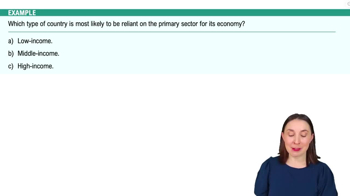
 00:18
00:18