Back

Research Methods in Sociology quiz

Control buttons has been changed to "navigation" mode.
1/15
  • What is primary data collection in sociological research?

    Primary data collection involves researchers gathering data firsthand through methods like questionnaires, interviews, fieldwork, and experiments. It offers greater control over research design but is more time-consuming and costly.
  • What is secondary data analysis?

    Secondary data analysis uses existing sources such as census data, archival records, or previous studies. It saves time and money but limits the researcher’s control over the research design.
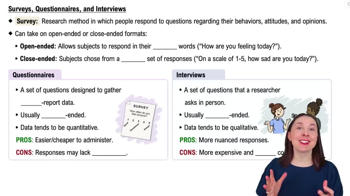
  • What is a survey in sociological research?

    A survey is a method where people respond to questions about their behaviors, attitudes, and opinions. Surveys can be open-ended or closed-ended.
  • How do open-ended and closed-ended survey questions differ?

    Open-ended questions allow subjects to respond in their own words, providing nuanced data. Closed-ended questions require choosing from fixed responses, making data easier to analyze but less detailed.
  • What is a questionnaire and how is it typically used?

    A questionnaire is a set of questions designed to gather self-report data, usually in a closed-ended format. It is commonly used for quantitative analysis and is easy and cheap to administer.
  • What is an interview in sociological research?

    An interview is a set of questions asked verbally, often in person or online, and usually open-ended. Interviews provide qualitative, nuanced data but are more time-consuming and expensive.
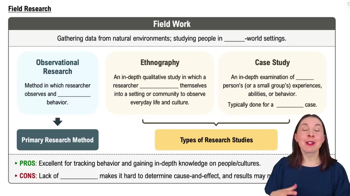
  • What is fieldwork in sociology?

    Fieldwork involves gathering data from natural environments to study people in real-world settings. It aims to observe natural behaviors and often uses observational research.
  • What is observational research?

    Observational research is a method where researchers observe and record behavior, often in natural settings. It seeks to capture objective, natural behavior without interference.
  • What is an ethnography?

    An ethnography is an in-depth qualitative study where a researcher immerses themselves in a community to observe everyday life and understand its culture. It provides rich, detailed knowledge about the group studied.
  • What is a case study?

    A case study is an in-depth examination of one person or a small group’s experiences, abilities, and behaviors, often focusing on unique cases. It yields specific, valuable insights but may not generalize to larger populations.
  • What are the main advantages and disadvantages of fieldwork?

    Fieldwork provides rich, in-depth data on behaviors and cultures but lacks control over variables, making it hard to determine cause and effect. Its results may not generalize, especially in case studies.
  • What is an experiment in sociological research?

    An experiment investigates cause and effect under highly controlled conditions, involving a hypothesis, random assignment, and comparison between experimental and control groups. It allows researchers to test the impact of an independent variable on a dependent variable.
  • What is random assignment and why is it important in experiments?

    Random assignment places participants into conditions at random to increase equivalency between groups. It helps control for individual differences that could confound results.
  • What is the Hawthorne effect?

    The Hawthorne effect occurs when participants change their behavior because they know they are being observed. This can affect the validity of experimental results.
  • What are the main pros and cons of experiments?

    Experiments offer high control over variables, enabling researchers to determine causality. However, their artificial settings may influence participant behavior and limit the generalizability of results.