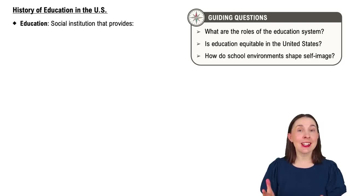
How is education defined as a social institution in the US?
Education is defined as a social institution that provides both formal knowledge, such as academics and job skills, and informal knowledge, like cultural norms and national values.
What are the two types of knowledge imparted by the education system?
The education system imparts formal knowledge (academics and job skills) and informal knowledge (cultural norms and national values).
Where did education typically take place in the US before the mid-1800s?
Before the mid-1800s, education in the US typically took place at home.
Who primarily received formal education in early US history?
Formal education was primarily reserved for upper-class men in early US history.
What two major historical periods led to changes in US education?
The Industrial Revolution and the Enlightenment led to significant changes in US education.
How did the Industrial Revolution affect education in the US?
The Industrial Revolution created a need for more skilled workers, leading to an emphasis on job skills in education.
What philosophical shift did the Enlightenment bring to education?
The Enlightenment promoted the idea that education should foster personal development and be accessible to all.
When did education in the US become mandatory in all states?
Education became mandatory in all 50 states in 1918.
What were the requirements for mandatory education established in 1918?
Mandatory education required completion until eighth grade or until the student turned 16.
By the mid-1960s, what percentage of US adults had a high school diploma?
By the mid-1960s, over 50% of US adults had a high school diploma.
What percentage of US adults held college degrees in the mid-1960s?
About 7% of US adults held college degrees in the mid-1960s.
What is the current percentage of US adults with a high school diploma?
Today, over 90% of US adults have a high school diploma.
What proportion of US adults currently hold college degrees?
Currently, about one third of US adults hold college degrees.
What are the manifest and latent functions of education discussed in the lesson?
Manifest functions include skill development, while latent functions involve socialization and shaping self-image.
What ongoing issues are highlighted in the history of US education?
Issues of equity and the role of schooling in shaping self-image within societal structures are highlighted.
 Back
Back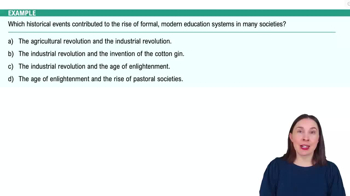
 00:37
00:37