Skip to main content
Sociology
My Course
Learn
AI Tutor
Study Guides
Flashcards
Explore
Try the app
My Course
Learn
AI Tutor
Study Guides
Flashcards
Explore
Try the app
Back
Historic Role of the Economy definitions
You can tap to flip the card.
Economy
You can tap to flip the card.
👆
Economy
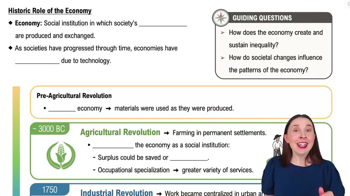
A social institution where goods are produced and exchanged, shaped by technological and societal changes over time.
Track progress
Control buttons has been changed to "navigation" mode.
1/15
Related flashcards
Recommended videos
Historic Role of the Economy quiz
Historic Role of the Economy
15 Terms
Guided course
01:15
Historic Role of the Economy Example 1
2
views
Guided course
04:21
Historic Role of the Economy
1
views
Terms in this set (15)
Hide definitions
Economy
A social institution where goods are produced and exchanged, shaped by technological and societal changes over time.
Agricultural Revolution
A period marked by the shift to farming and permanent settlements, leading to surplus, trade, and occupational specialization.
Surplus
An excess of goods beyond immediate needs, enabling storage, trade, and the foundation of economic systems.
Occupational Specialization
The development of distinct jobs, allowing individuals to master specific crafts and improve service quality.
Industrial Revolution
An era beginning around 1750, characterized by factory-based production, mass goods, and urban work centralization.
Mass Production
The creation of large quantities of standardized goods, increasing availability and driving consumer demand.
Consumerism
A social pattern where increased acquisition and consumption of goods becomes a driving economic force.
Class Structure
The organization of society into groups based on economic roles, notably capitalists and workers after industrialization.
Capitalist Class
A group owning production means, distinguished from workers, and gaining prominence during industrialization.
Working Class
Individuals who sell their labor, often in factories, forming a distinct group in industrial societies.
Transportation
Systems like railroads that connected national and global markets, facilitating economic expansion.
Information Revolution
A period starting in the 1950s, driven by computer technology, shifting economies toward services and technology.
Postindustrial Economy
An economic system focused on services and technology, with reduced reliance on factory work.
White-Collar Jobs
Professional or managerial positions, often requiring specialized knowledge, that expanded with technological advances.
Global Interdependence
A condition where national economies are closely linked through global markets and trade.
 BackBack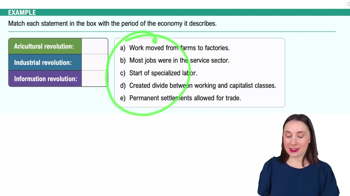
 01:15
01:15