Skip to main content
Sociology
My Course
Learn
AI Tutor
Study Guides
Flashcards
Explore
Try the app
My Course
Learn
AI Tutor
Study Guides
Flashcards
Explore
Try the app
Back
Ethnocentrism vs. Cultural Relativism definitions
You can tap to flip the card.
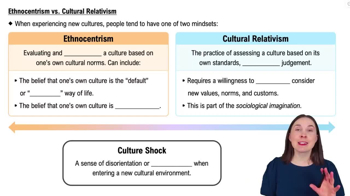
Ethnocentrism
You can tap to flip the card.
👆
Ethnocentrism
Judging unfamiliar customs by one's own cultural standards, often with an assumption of superiority over other ways of life.
Track progress
Control buttons has been changed to "navigation" mode.
1/15
Related flashcards
Recommended videos
Ethnocentrism vs. Cultural Relativism quiz
Ethnocentrism vs. Cultural Relativism
15 Terms
Guided course
01:28
Ethnocentrism vs. Cultural Relativism Example 1
1
views
Guided course
03:16
Ethnocentrism vs. Cultural Relativism
1
views
Terms in this set (15)
Hide definitions
Ethnocentrism
Judging unfamiliar customs by one's own cultural standards, often with an assumption of superiority over other ways of life.
Cultural Relativism
Assessing unfamiliar customs based on their own context, requiring neutrality and suspension of personal biases.
Culture Shock
A feeling of disorientation or discomfort experienced when exposed to a new cultural environment.
Cultural Norms
Shared expectations and rules guiding behavior within a specific group or society.
Sociological Imagination
The ability to set aside personal beliefs to objectively consider different cultural perspectives.
Cultural Integration
The process of adapting to and blending with a new cultural environment.
Socialization
The lifelong process through which individuals learn and internalize the values and practices of their society.
Cultural Universals
Elements, patterns, or traits common to all human societies, despite cultural differences.
Mindset
A mental framework influencing how individuals interpret and respond to new cultural experiences.
Values
Deeply held beliefs that guide judgments about what is important or desirable within a culture.
Customs
Established practices or habitual actions characteristic of a particular group or society.
Beliefs
Convictions or acceptances that certain things are true or real, often shaped by cultural background.
Discomfort
An emotional or psychological unease often arising during exposure to unfamiliar cultural settings.
Superiority
A perception that one's own cultural practices or values are better than those of others.
Nonjudgment
A stance of withholding evaluation or criticism when encountering unfamiliar cultural practices.
 BackBack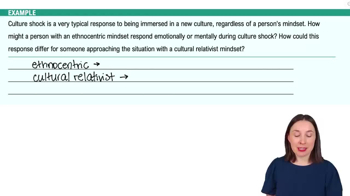
 01:28
01:28