What is the main difference between values and beliefs in a society?
Values are broad concepts about what is good and important, while beliefs are specific convictions explaining how those values apply in daily life.
How can values influence laws and public policy?
Values are often shared by most people in a society and can shape laws and public policy by reflecting what is considered good and desirable.
What is an example of a value and a related belief about education?
A value might be that education is important, while a belief could be that everyone should have access to free, high-quality education.
What is ideal culture?
Ideal culture refers to the standards and values a society would like to embrace and live up to, often expressed in laws and public rhetoric.
How does real culture differ from ideal culture?
Real culture is the actual behaviors and practices observed in everyday life, which may align with or contradict ideal culture.
What example illustrates the gap between ideal and real culture in the United States?
While 84% of Americans value respecting rights and freedoms, only 14% believe this actually describes the U.S. very well, showing a gap between ideals and reality.
What are norms in sociology?
Norms are shared rules and expectations of behavior that guide members of a society and help maintain social order.
What is the difference between mores and folkways?
Mores are norms with moral significance and legal consequences, while folkways are norms for routine interactions without strong moral implications.
How does society typically react to violations of mores?
Violations of mores are often perceived as shameful or shocking and may even be illegal.
What is an example of a folkway?
Wearing casual attire to a formal business meeting is a folkway violation; it may be seen as odd or rude but is not illegal.
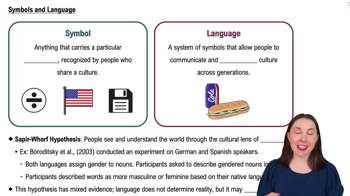
What is a symbol in the context of culture?
A symbol is anything that carries a particular meaning recognized by members of a culture, helping them navigate and make sense of everyday life.
How can experiencing culture shock relate to symbols?
Culture shock often occurs when encountering unfamiliar symbols and language, making it difficult to understand and navigate a new environment.
What is language and its role in culture?
Language is a system of symbols that allows people to communicate complex ideas and transmit culture across generations.
What does the Sapir-Whorf hypothesis propose?
The Sapir-Whorf hypothesis suggests that people see and understand the world through the cultural lens of language, which can influence perception.
What evidence supports the Sapir-Whorf hypothesis?
Studies show that speakers of languages with gendered nouns describe objects differently based on their native language, indicating language can influence thought.
 Back
Back
 05:17
05:17