Skip to main content
Sociology
My Course
Learn
AI Tutor
Study Guides
Flashcards
Explore
Try the app
My Course
Learn
AI Tutor
Study Guides
Flashcards
Explore
Try the app
Back
Dimensions of Social Inequality definitions
You can tap to flip the card.
Income
You can tap to flip the card.
👆
Income
Earnings from work or investments, representing money received by individuals or families within a given period.
Track progress
Control buttons has been changed to "navigation" mode.
1/20
Related flashcards
Recommended videos
Dimensions of Social Inequality quiz
Dimensions of Social Inequality
15 Terms
Guided course
01:04
Dimensions of Social Inequality Example 1
Guided course
04:37
Dimensions of Social Inequality
1
views
Terms in this set (20)
Hide definitions
Income
Earnings from work or investments, representing money received by individuals or families within a given period.
Income Inequality
The uneven distribution of earnings among individuals or groups, often measured by comparing different population segments.
Wealth
Total value of money and assets owned minus outstanding debts, reflecting overall financial resources.
Wealth Inequality
The disproportionate distribution of assets and debts, often more extreme than disparities in earnings.
Debt
Financial obligations or money owed, which can result in negative net worth for individuals or families.
Socioeconomic Status
A person's or family's social standing based on income, education, and occupation, influencing life chances.
Occupational Prestige
Social respect and status attributed to a job, often linked to education, income, and perceived social power.
Social Stratification
A system by which society ranks categories of people in a hierarchy, affecting access to resources.
Class Conflict
Tensions or struggles between social groups with differing economic interests, often rooted in inequality.
Assets
Valuable resources owned, such as property or investments, contributing to overall financial standing.
Median Income
The middle value of earnings in a population, with half earning more and half earning less.
High-Income Countries
Nations with advanced economies and high average earnings, often exhibiting pronounced inequality.
Social Power
The ability to influence or control others, often associated with certain occupations or social positions.
Stereotype
Oversimplified and generalized beliefs about groups, which can affect perceptions of job status.
Bias
A tendency to favor or disadvantage certain groups, impacting social judgments like occupational ratings.
Social Judgments
Collective evaluations or opinions about individuals or roles, shaped by cultural norms and biases.
Education
Formal learning or training, often linked to higher job status, income, and occupational respect.
Industrialized Nations
Countries with developed economies and advanced infrastructure, where inequality patterns are often studied.
Negative Wealth
A financial state where debts exceed assets, resulting in a net loss of resources.
Social Class
A group of people with similar economic positions, often determined by income, wealth, and occupation.
 BackBack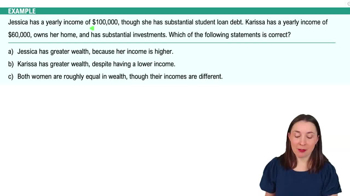
 01:04
01:04