Skip to main content
Sociology
My Course
Learn
AI Tutor
Study Guides
Flashcards
Explore
Try the app
My Course
Learn
AI Tutor
Study Guides
Flashcards
Explore
Try the app
Back
Defining Family quiz
You can tap to flip the card.
How do sociologists define family?
You can tap to flip the card.
👆
How do sociologists define family?
Family is a socially recognized group that provides care, education, and economic support, usually linked by marriage, blood, or adoption.
Track progress
Control buttons has been changed to "navigation" mode.
1/15
Related flashcards
Recommended videos
Defining Family definitions
Defining Family
13 Terms
Guided course
02:04
Defining Family
1
views
Guided course
01:10
Defining Family Example 1
1
views
Terms in this set (15)
Hide definitions
How do sociologists define family?
Family is a socially recognized group that provides care, education, and economic support, usually linked by marriage, blood, or adoption.
What is considered the cornerstone of family in most societies?
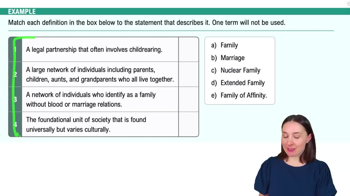
Marriage is viewed as the cornerstone of family, serving as its base unit.
What are the typical components of marriage according to sociologists?
Marriage often involves sexual activity, childrearing, and financial cooperation between partners.
What is a nuclear family?
A nuclear family consists of one or two parents and their children living together under one roof.
Where are nuclear families most commonly found?
Nuclear families are most common in high-income, highly industrialized nations.
What is an extended family?
An extended family includes a nuclear family plus other relatives such as grandparents, aunts, uncles, or cousins living together.
In which types of societies are extended families most prevalent?
Extended families are most common in low-income, less industrialized nations.
What are families of affinity?
Families of affinity are groups who consider themselves family despite lacking blood relations or legal ties.
Where are families of affinity most commonly found?
Families of affinity are most common in high-income, highly industrialized nations.
What are the three main ways people are linked in a family?
People in a family are usually linked by marriage, blood relation, or adoption.
Why is family considered a cultural universal?
Family exists in every society and culture across the globe, making it a cultural universal.
What social functions does family provide?
Family provides care, education, and economic support to its members.
How do sociologists use family structures to understand society?
Family structures help sociologists identify cultural universals and social institutions that shape caregiving and socialization.
What distinguishes a family of affinity from other family types?
A family of affinity is based on chosen bonds rather than legal or blood ties.
What is the role of marriage in forming families?
Marriage forms the legal partnership that often serves as the foundation for family units.
 BackBack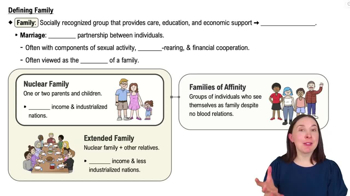
 02:04
02:04