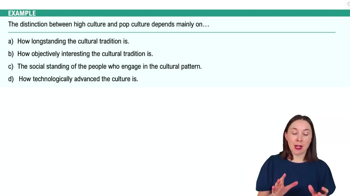
What is high culture and what does it require for participation?
High culture refers to cultural patterns that distinguish a society's elite members and requires cultural capital such as wealth, status, or social connections to participate.
How is popular culture different from high culture?
Popular culture consists of cultural patterns that are widespread and accessible to most people in society, unlike high culture which is exclusive.
Give two examples of high culture in the United States.
Examples include attending a gala or going to an opera.
What are some examples of popular culture activities?
Examples include watching sports games, popular TV shows, movies, county fairs, or engaging on social media.
Why are high culture activities often associated with intellectualism and prestige?
They are linked to society's elite members and require cultural capital, but are not inherently better than popular culture activities.
Can the distinction between high culture and popular culture change over time or across societies?
Yes, these categories are fluid and can shift over time or differ between cultures.
How did Shakespeare's plays shift between categories of culture over time?
They were once considered mainstream (pop culture) but are now associated with high culture in the U.S.
What is an example of a food that is considered pop culture in one society but high culture in another?
Salmon roe is mainstream in Japan but considered a delicacy or less accessible in the U.S.
What is a subculture?
A subculture is a smaller cultural group with distinct values and norms that exists within a larger culture and operates smoothly within mainstream society.
List three types of subcultures.
Examples include racial/ethnic subcultures (e.g., Korean Americans), lifestyle-based subcultures (e.g., vegans), and niche subcultures (e.g., fans of a specific TV show).
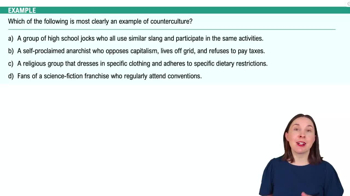
What is a counterculture?
A counterculture is a group that actively rejects and opposes the widely accepted norms and values of the dominant society.
How do countercultures differ from subcultures?
Countercultures oppose the dominant culture, while subcultures coexist smoothly within it.
Are all countercultures subcultures? Are all subcultures countercultures?
All countercultures are subcultures, but not all subcultures are countercultures.
Give two examples of countercultures.
Examples include goth or punk communities and activist groups like feminists or anti-war protesters.
How can countercultures range in their impact on society?
Countercultures can be healthy, neutral, or harmful, ranging from lifestyle groups to extreme cults.
 Back
Back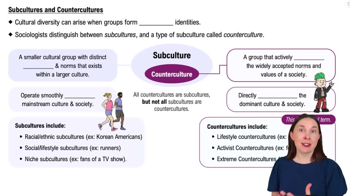
 02:50
02:50