Back

What is Psychology? definitions

Control buttons has been changed to "navigation" mode.
1/15
  • Psychology

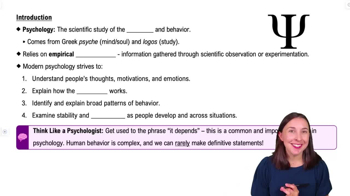
    Scientific field focused on understanding mind and behavior through observation, experimentation, and analysis of mental processes.
  • Empirical Evidence

    Information obtained via scientific observation or experimentation, forming the foundation for research and practice.
  • Mind

    Non-physical aspect associated with thoughts, emotions, and consciousness, often contrasted with the physical body.
  • Behavior

    Observable actions or responses of individuals, studied to identify patterns and underlying motivations.
  • Dualism

    Philosophical view proposing a distinction between an immaterial mind and a physical body.
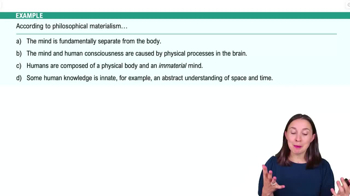
  • Materialism

    Perspective asserting that mental events are identical to physical processes in the brain.
  • Empiricism

    Philosophy emphasizing that all knowledge originates from sensory experience and learning.
  • Nativism

    Belief that certain knowledge or abilities are innate and present at birth, facilitating further learning.
  • Nature versus Nurture

    Debate concerning the relative influence of genetic inheritance and environmental factors on development.
  • Clinical Practice

    Application of psychological principles and research to assess, diagnose, and treat mental health issues.
  • Research Domain

    Area focused on generating new knowledge through scientific methods to inform psychological understanding.
  • Lifespan

    Entire course of human development from infancy to old age, including stability and change over time.
  • Cognition

    Mental processes involved in acquiring, processing, and storing information, including thinking and reasoning.
  • Philosophy

    Discipline that inspired early psychological thought by exploring fundamental questions about mind and knowledge.
  • Tabula Rasa

    Concept describing the mind as a blank slate at birth, shaped entirely by experience.