Skip to main content
Introduction to Psychology
My Course
Learn
Exam Prep
AI Tutor
Study Guides
Flashcards
Explore
Try the app
My Course
Learn
Exam Prep
AI Tutor
Study Guides
Flashcards
Explore
Try the app
Back
Summary of Important Brain Regions definitions
You can tap to flip the card.
Forebrain
You can tap to flip the card.
👆
Forebrain
Most evolutionarily advanced brain region, responsible for logic, rational thought, and complex cognitive functions.
Track progress
Control buttons has been changed to "navigation" mode.
1/15
Related flashcards
Related practice
Recommended videos
Summary of Important Brain Regions quiz #1
Summary of Important Brain Regions
11 Terms
Summary of Important Brain Regions
3. Biological Psychology
7 problems
Topic
Nicole
The Endocrine System
3. Biological Psychology
7 problems
Topic
Nicole
3. Biological Psychology - Part 1 of 2
5 topics
14 problems
Chapter
Nicole
3. Biological Psychology - Part 2 of 2
5 topics
12 problems
Chapter
Nicole
Guided course
07:55
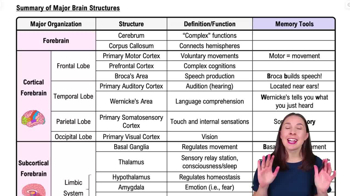
Summary of Major Brain Structures
5
views
Terms in this set (15)
Hide definitions
Forebrain
Most evolutionarily advanced brain region, responsible for logic, rational thought, and complex cognitive functions.
Cerebrum
Largest brain part, divided into two hemispheres, governing higher-order thinking, memory, and voluntary actions.
Corpus Callosum
Thick bundle of nerve fibers connecting the left and right cerebral hemispheres, enabling communication between them.
Frontal Lobe
Front brain region involved in voluntary movement, executive functions, inhibitory control, and speech production.
Primary Motor Cortex
Area within the frontal lobe that initiates and controls voluntary muscle movements.
Broca's Area
Region near the motor cortex essential for producing spoken language and coordinating speech muscles.
Temporal Lobe
Side brain region near the ears, crucial for processing auditory information and language comprehension.
Wernicke's Area
Temporal lobe region vital for understanding spoken and written language.
Parietal Lobe
Upper middle brain region processing touch, spatial awareness, and internal body sensations.
Primary Somatosensory Cortex
Parietal lobe area receiving and interpreting sensory information from the body, such as touch and proprioception.
Occipital Lobe
Rear brain region dedicated to visual processing and interpretation.
Basal Ganglia
Subcortical structures regulating movement initiation, inhibition, and coordination with the motor cortex.
Thalamus
Central relay station for sensory signals, also involved in consciousness and sleep regulation.
Limbic System
Group of structures managing emotion, memory, and homeostasis, including the hypothalamus, amygdala, and hippocampus.
Cerebellum
Hindbrain structure resembling a small brain, responsible for coordination, balance, and precise motor control.
 BackBack
 07:55
07:55